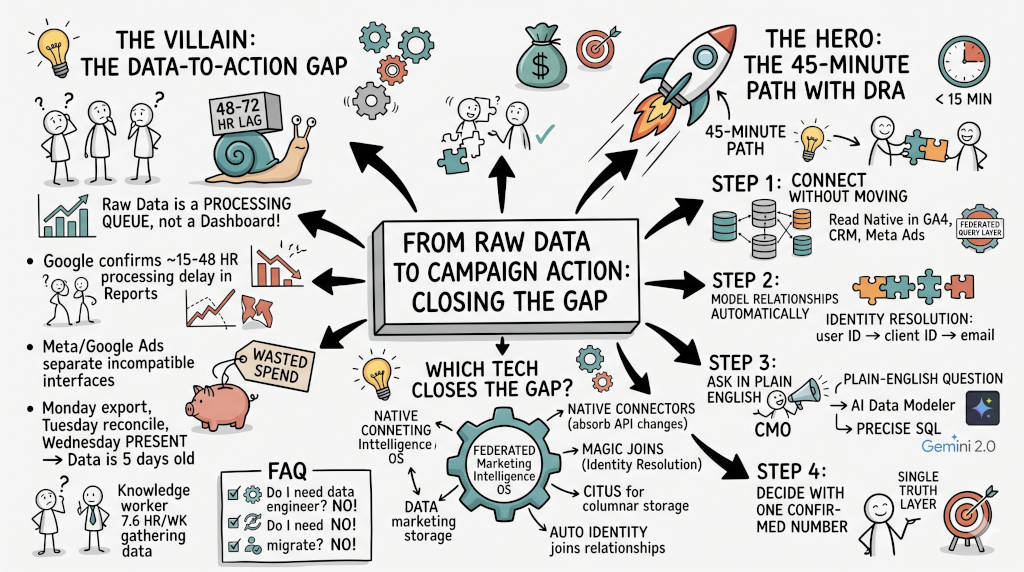
Summary: Most marketing teams sit on raw data for 48 to 72 hours before acting. By then, the window has closed. This article explains why the gap between data collection and campaign action is the single greatest speed liability a CMO carries. It defines the exact four-step path from raw signal to confirmed decision. It shows how automated intelligence compresses that cycle from days to under 15 minutes. It explains how DRA removes the manual bottleneck entirely so your team stops translating data and starts leading on it.
1. What Does "Raw Data" Actually Mean for a CMO Today?
The Answer: Raw data is every event, click, conversion, and revenue signal your campaigns generate before it is cleaned, joined, and modeled into a decision. Your platforms collect it in real time. Your team cannot act on it that fast. GA4 holds raw events in a processing queue for up to 48 hours before they appear as finalized reports. Your CRM holds lead records that are never joined to ad spend. Your ad platforms hold performance signals in isolated accounts. Raw data is not a dashboard. It is a queue your team is too slow to process before the market moves.
The Gap Between Collection and Action
Every second of every campaign, your platforms are collecting signals. A click on a paid ad at 9 AM on Tuesday is captured as a GA4 event immediately. But that event does not appear in your finalized report until 3:30 PM the following day, according to Google's own processing documentation (Google, n.d.-a). Your team cannot act on data that has not been reported. That single architectural fact delays every campaign decision by a minimum of 15 hours under ideal conditions, and up to 48 hours when processing is delayed.
Your CRM records the lead at the same moment. Your Meta Ads platform records the click attribution separately. None of these systems communicate natively. Your analyst must export all three, join them manually, and rebuild a report that connects the click to the lead to the revenue. That process does not take 15 minutes. For most teams, it takes three days.
The raw data exists. The infrastructure to act on it does not.
2. Why Does It Take Marketing Teams Days to Act on Their Own Data?
The Answer: Marketing teams take days to act because the infrastructure between data collection and the decision layer is entirely manual. GA4 finalizes daily data in Reports by 3:30 PM the day after collection under normal conditions, but processing can take 24 to 48 hours when delays occur (Google, n.d.-a). Platforms like Meta Ads and Google Ads hold campaign performance in separate, incompatible interfaces. Your analyst exports on Monday, reconciles discrepancies on Tuesday, and presents a dashboard on Wednesday on data that is already five days old. The bottleneck is not analyst skill. It is architecture designed for data storage, not decision speed.
The Manual Compensation Cycle
The standard weekly reporting cycle in most marketing teams follows a predictable pattern. Monday: export. Tuesday: reconcile. Wednesday: present. Thursday: decide. By Friday, the window the data described has already closed.
Research from McKinsey Global Institute confirms that knowledge workers spend 19 percent of their working week searching for and gathering information (McKinsey Global Institute, 2012). For a standard 40-hour week, that is 7.6 hours. Over 50 working weeks, that is 380 hours per year. This figure applies before adding time for cleaning exports, correcting formula errors, and rebuilding reports after platform updates.
Salesforce research confirms a separate but overlapping drain. Marketers managing two to three platforms waste a minimum of 3.55 hours per week on manual data management (Salesforce, 2023). Scale that to a team managing GA4, Meta Ads, Google Ads, a CRM, and attribution data simultaneously, and 8 hours per week is the conservative baseline for manual compensation.
Why GA4 Accelerates the Problem
GA4 uses an event-scoped data model that processes each user interaction through multiple pipeline stages before finalizing report data. Google's own documentation confirms that data processing can take 24 to 48 hours (Google, n.d.-a). For attribution reports that apply machine learning inference, the processing window extends to 4 to 8 hours beyond standard daily data pipelines (Google, n.d.-b). Your team is reading a history lesson while the market moves ahead of it.
3. What Is the Real Cost of the Data-to-Action Gap?
The Answer: The cost of the data-to-action gap is measured in wasted spend, missed windows, and lost competitive ground. When a campaign underperforms on Saturday morning, your team will not see confirmed numbers until Monday afternoon. You burn budget during that window. When a trend peaks on Friday, your Wednesday report arrives after the opportunity has closed. For a brand running $500,000 per month in ad spend, a consistent 48-hour action gap is not an operational inconvenience. It is a measurable revenue leak that compounds every week the infrastructure remains unchanged.
The Missed Window Multiplier
Every delayed decision creates two costs simultaneously. First, you continue spending on a losing creative or underperforming audience segment while the data sits in queue. Second, you cannot scale a winning signal until the data confirms it. Both costs run in parallel.
McKinsey's research on data-driven decision speed is direct: organizations with automated data pipelines make decisions 40 percent faster than those relying on manual reporting cycles (McKinsey Global Institute, 2012). That speed gap determines which brand captures the window and which brand pays to miss it. Over a full quarter of campaigns, the compounding advantage of a faster competitor is not marginal. It is category-defining.
The ROI Proof Problem
The data-to-action gap does not just cost you speed. It costs you executive credibility. When your CFO asks why the dashboard shows campaign success but the bank account is flat, the answer is almost always a timing mismatch between platform-reported metrics and confirmed revenue. Attribution credit in GA4 can change for up to 12 days after a key event is recorded, as modeling continues to process (Google, n.d.-a). The number at 9 AM does not match the number at 5 PM.
HubSpot's State of Marketing Report found that 31 percent of marketers still cannot track ROI as a top metric, despite having analytics platforms deployed (HubSpot, 2026). The data exists. The infrastructure to act on it in time does not.
4. What Are the Four Steps to Turn Raw Data into Campaign Action in 15 Minutes?
The Answer: The four steps are: connect your sources without moving the data, model identity relationships automatically instead of manually, ask a plain-English question to surface the confirmed signal, and make one decision before the next meeting starts. Each step replaces a manual task that currently takes between 30 minutes and three days. When the infrastructure supports all four steps simultaneously, the data-to-action cycle compresses from days to under 15 minutes. The bottleneck is not the data. It is the architecture between the data and the decision-maker.
Step 1: Connect Without Moving
Traditional data workflows require moving data from its source into a central warehouse. That pipeline takes hours to days to build, maintain, and repair when an upstream API changes. A federated query layer eliminates this step entirely. It reads data where it lives. Google Ads stays in Google. GA4 stays in Google. Your CRM stays in place. The query layer reads all three simultaneously and returns a joined result in seconds.
This single architectural shift removes the longest step in the manual cycle. There is no export. There is no import. There is no staging table. There is only a live query against live data, executed before your morning meeting ends.
Step 2: Model Relationships Automatically
Your Google Ads account uses user IDs. Your CRM uses email addresses. Your GA4 uses client IDs. These three identifiers describe the same person at different moments in their purchase journey. Connecting them manually requires SQL, mapping tables, and maintenance every time a platform updates its naming convention.
Automatic identity resolution infers these relationships without human intervention. When a lead appears in your CRM, the system identifies the corresponding GA4 client ID and the Google Ads user ID automatically. Your spend connects to your revenue in seconds, not days.
Step 3: Ask in Plain English
The traditional path from raw data to campaign signal requires an analyst to write a query, run it, format the output, and present it. That path takes hours. It requires specialist knowledge your CMO team should not need to source on demand.
An AI Data Modeler converts a plain-English question into precise SQL. You type: "Which campaign drove the most revenue-qualified leads this week compared to last week?" The engine returns a modeled answer in under 60 seconds. No analyst queue. No SQL. No wait until Thursday.
Step 4: Decide with One Confirmed Number
The final step is the one most often skipped. Teams receive reports, discuss them, and delay action because no single number is agreed upon as the verified truth. Your dashboard shows one figure. Your platform reports another. Your analyst explains the discrepancy is expected.
A single-source truth layer eliminates the argument. When every stakeholder reads from the same modeled layer, the debate about which number is correct ends. The meeting moves to the decision.
5. Which Technology Actually Removes the Translation Gap?
The Answer: The technology that removes the translation gap is a Federated Marketing Intelligence OS. This is not a dashboard tool. It is not a BI platform. It is an operating system for marketing data that connects sources natively, models relationships automatically, and serves confirmed answers in plain English. GA4 remains your data source. Meta Ads remains your data source. Your CRM remains your data source. The intelligence OS sits above all of them and joins the data in real time without waiting for GA4 to finalize its pipeline.
Why BI Tools Cannot Close This Gap
Traditional BI tools like Tableau and Looker were designed for analysts working with stable, pre-cleaned data warehouses as their input. Marketing data is not stable. It arrives in incompatible formats, updates continuously, and changes schema without warning. When GA4 updates its attribution model, your Looker dashboard breaks. When Meta Ads changes its column naming conventions, your export pipeline fails.
A Federated Marketing Intelligence OS absorbs these changes at the connector level. Your dashboard never goes dark because the intelligence layer handles API changes before your team notices them. The output is continuous even when the platforms change beneath it.
Why the 15-Minute Benchmark Is Achievable
The 15-minute benchmark is not aspirational. It is the direct result of eliminating the four steps that currently extend the data-to-action cycle. No export. No import. No manual identity join. No analyst queue. When a federated layer is connected, the first confirmed answer returns in under 15 minutes of initial setup. That is not a performance claim. It is the output of removing manual bottlenecks from a process that was never designed to be manual in the first place.
The 40 percent speed advantage that McKinsey attributes to automated data pipelines is not achieved by working harder (McKinsey Global Institute, 2012). It is achieved by removing the infrastructure that forces your team to work manually on tasks that do not require human judgment.
6. How Does DRA Compress the Data-to-Action Cycle to Under 15 Minutes?
The Answer: DRA is a Federated Marketing Intelligence OS built on PostgreSQL with Citus for columnar storage. It processes millions of rows in seconds without data sampling. The Federated Query Layer connects to GA4, Google Ads, Meta Ads, and your CRM natively. Magic Joins resolve identity relationships between user IDs and email addresses without manual mapping. The AI Data Modeler, powered by Gemini 2.0, converts a plain-English question into precise SQL and returns a modeled answer in under 60 seconds. Report lag drops from 48 hours to under one minute. Your team acts on confirmed data before the morning meeting ends.
What the 15-Minute Workflow Looks Like Inside DRA
You open DRA at 8:45 AM. Your Sync Schedulers have already refreshed your GA4, Meta Ads, and Google Ads data. Your Magic Joins have already connected your CRM leads to their original ad touchpoints.
You type: "Which paid social campaigns drove the most revenue-qualified leads this week compared to last week?" The AI Data Modeler returns a ranked table in under 60 seconds. You see the delta. You identify the winning creative. You confirm the budget allocation before 9 AM.
That sequence requires zero exports. Zero SQL. Zero analyst intervention. It requires 15 minutes and a clear question.
Your Scientist and Your Artist Both Win
The Scientist in your leadership team requires financial-grade precision. DRA delivers it. Every number traces to a verified source. No sampling. No inference delays that leave your figures unstable until tomorrow.
The Artist in your leadership team requires the freedom to pivot on live signals before the window closes. DRA delivers it. Every question returns a modeled answer in under 60 seconds so the creative call is made before the opportunity disappears.
The 48-hour lag is the villain. DRA removes it permanently. Your team leads the market instead of reacting to it.
Raw Data to Campaign Action: FAQ
Q: Does a 15-minute data-to-action cycle require a data engineer on staff? A: No. DRA's AI Data Modeler converts plain-English questions into SQL automatically. Your CMO team asks questions without writing queries. The engineering complexity is inside the platform, not on your team.
Q: Do I need to migrate my existing data to make this work? A: No. DRA's Federated Query Layer reads data where it lives. GA4, Google Ads, Meta Ads, and your CRM stay in place. There is no data migration. There is no ETL pipeline to build or maintain.
Q: My team pulls reports every morning. Is that not fast enough? A: Daily manual exports compensate for the lag but do not remove it. You are still reading processed data that is 15 to 48 hours old, and you are adding manual labor hours to produce it. Compensation is not the same as resolution. Automation removes the lag at the source instead of managing the symptom at daily cost.
Q: What if GA4 takes longer than 48 hours to finalize attribution data? A: DRA's Federated Query Layer does not wait for GA4's processing pipeline. It joins GA4 event data with live signals from ad platforms that refresh faster. Your decision is not blocked by GA4's timeline. It is based on the most current confirmed data from each source simultaneously.
Q: How accurate is the data before GA4 completes full processing? A: DRA reads from multiple source layers and flags the completeness level of every figure before you act on it. When intraday data is the most current available, the platform displays that status. When daily data is confirmed, the figures update automatically. You always know what you are deciding on.
Q: Can the 15-minute benchmark hold across a full enterprise marketing stack? A: Yes. The benchmark applies to joined queries across GA4, Google Ads, Meta Ads, and CRM data running simultaneously. PostgreSQL with Citus columnar storage processes millions of rows in seconds. The performance does not degrade as the query complexity or data volume increases.
The Gap Closes the Moment You Connect. Start That Conversation Today.
Your competitors are not waiting for Thursday's report. They are acting on Friday's data. Every week you operate on a 48-hour delay, the distance between your decision speed and theirs increases.
DRA closes that gap permanently. Your team connects your sources once. Magic Joins resolve your identity data automatically. The AI Data Modeler answers your questions in plain English before the next meeting starts.
The 15-minute data-to-action cycle is not a feature upgrade. It is the minimum standard for a CMO who intends to lead.
Contact our enterprise team to build your data-to-action plan today.
References
Google. (n.d.-a). [GA4] Data freshness and service level agreement constraints. Google Support. https://support.google.com/analytics/answer/12233314
McKinsey Global Institute. (2012, July). The social economy: Unlocking value and productivity through social technologies. McKinsey & Company. https://www.mckinsey.com/industries/technology-media-and-telecommunications/our-insights/the-social-economy
Salesforce. (2023). State of marketing (9th ed.). Salesforce. https://www.salesforce.com/resources/research-reports/state-of-marketing/
Google. (n.d.-b). About data-driven attribution. Google Support. https://support.google.com/analytics/answer/10596866
HubSpot. (2026). State of marketing report 2026. HubSpot. https://www.hubspot.com/state-of-marketing