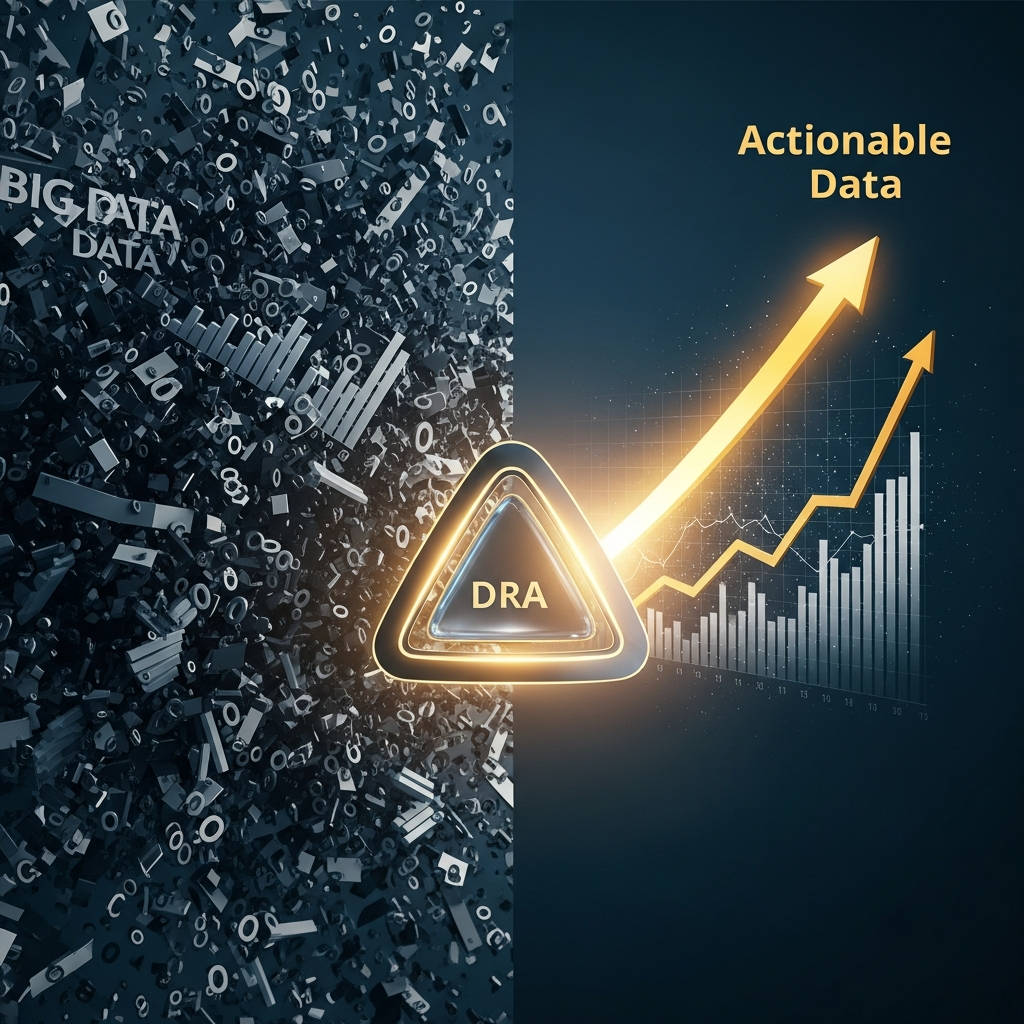
Summary: Most marketing teams treat data volume as a measure of success. More events, more signals, more dashboard rows — all taken as proof that the system is working. But volume without validation is noise. When tracking pixels break, naming conventions drift across platforms, and duplicate user IDs multiply, the dashboard becomes a fiction that costs real money. The difference between big data and actionable data is not the number of events collected. It is the percentage of those events that can be traced to a real outcome. This article explains how to measure that gap, close it, and restore trust in your reporting — starting today, with or without new software.
Your marketing dashboard shows rising revenue. Your bank account shows flat deposits. That gap is not a reporting error. It is a data quality leak — and it is costing your organization strategic velocity, budget confidence, and boardroom trust. The companies that close this gap in 2026 will not be the ones with the most data. They will be the ones that stop mistaking volume for truth.
1. What is the real difference between big data and actionable data?
The Answer: Big data is every event your platforms collect. Actionable data is every event that connects to a outcome you can defend in a boardroom. The gap between them is the data quality problem most CMOs are still paying for in hidden costs — wasted ad spend, misattributed revenue, and teams that spend their days cleaning spreadsheets instead of building strategy.
Every platform you run — Google Ads, Meta, GA4, CRM, email — generates thousands of events per second. That is big data. But when an event lands in your dashboard with a null source, a broken pixel, or a timestamp from a different time zone, it stops being useful. It becomes noise.
Marketing leaders are drowning in noise and starving for signal. A 2026 analysis from Marketing Dive states that "inaccurate data feeding AI systems creates consequences that compound quickly: missing values lead to flawed models, outdated attributes produce misleading insights, and duplicate records create wasted spend" (MacPherson, 2026). The volume of your data has never been the problem. The integrity of your data has always been the problem.
The Cost of Noise
Your team cannot optimize ROI while they audit a million rows of garbage. Every hour a strategist spends reconciling GA4 conversions against bank deposits is an hour they are not building campaigns, testing creative, or finding new growth channels. That is not a data problem. That is a leadership problem disguised as a technical one.
2. Why does data quality matter more than data volume in marketing analytics?
The Answer: Data quality matters more because volume without validation multiplies errors instead of magnifying truth. A large dataset with broken tracking produces twice the misinformation in half the time. Quality data — verified, deduplicated, and continuously refreshed — is the only foundation from which you can make fast, confident decisions.
The industry has treated scale as a competitive differentiator for a decade. Vendors compete on household reach and signal volume because big numbers are easy to sell. But the market is shifting. A report from Audience Acuity notes that "much of what gets counted as a 'signal' isn't stable, permissioned, or even accurate — it's often redundant or expired, representing the digital dust of fragmented identities" (Audience Acuity, 2026).
The shift from volume to validation is not theoretical. It is operational.
What Quality Actually Unlocks
When your data is clean, every downstream action improves. Attribution reflects real conversions, not inflated last-click credit. Audience targeting reaches verified people, not fragmented IDs. Media optimization optimizes toward profit, not platform vanity metrics.
Accuracy creates confidence. Confidence creates speed. Speed creates market advantage.
3. How do you audit your data for quality right now — without buying software?
The Answer: You can audit your marketing data quality today with three checks. First: compare your CRM sales totals to your ad platform conversion totals for the same period. Second: measure the percentage of GA4 sessions with a missing source or medium — anything above 5 percent is a leak. Third: check for duplicate user IDs in your database. These three diagnostics reveal the gap between what your dashboards claim and what your bank account confirms.
The Certainty Benchmark
A score of 95 percent or higher means your data is ready for decisions. Below that, you are paying a tax. Every percentage point of uncertainty slows your decision cycle, erodes team confidence, and reduces the return on every dollar you spend on media.
Integrated Marketing Solutions (IMS) describes the pattern clearly: "Budgets were increased on channels that appeared to perform well but were over-attributed. Underperforming campaigns were kept alive due to tracking gaps. Customer acquisition costs were underestimated" (IMS, 2026). These failures compound. A 2 percent tracking leak today becomes a 15 percent budget misallocation by next quarter.
4. How does garbage-in, garbage-out affect AI-powered marketing decisions?
The Answer: AI models cannot fix bad inputs. When a machine learning model trains on data with missing values, duplicate records, and inconsistent naming conventions, it does not get confused — it gets confidently wrong. It optimizes toward the wrong signal. It scales mistakes across your entire ecosystem at machine speed.
The cost of garbage-in, garbage-out has never been higher. Marketing automation now makes thousands of decisions per day — bid adjustments, audience inclusions, creative rotations. Each decision inherits the quality of the data behind it. A stale phone number in your CRM fragments a matched audience. A broken tracking pixel under-weights your best channel by 40 percent. A duplicate user ID inflates your reach and deflates your conversion rate.
Marketing Dive frames the risk precisely: "Errors that once impacted a single campaign can now cascade across entire marketing ecosystems in real time, influencing activation, optimization, and business outcomes simultaneously" (MacPherson, 2026).
The Speed Trap
Bad data is expensive at any volume. Bad data at AI scale is existential. You cannot use automation to escape a foundation you never validated.
5. How do you move from big data to actionable data in 30 days?
The Answer: Stop collecting. Start validating. Audit your three highest-spend channels first. Fix broken tracking pixels before you build new dashboards. Standardize naming conventions across platforms. Deduplicate your user records. These four actions take 30 days and cost nothing but focus. They will return more strategic velocity than any new tool you could buy.
The 30-Day Action Plan
Diagnose your tracking gap. Run a source/medium report in GA4. Count the percentage of sessions with unidentified sources. If it is above 5 percent, your attribution is unreliable.
Reconcile spend to revenue. Export last month's ad platform conversions and compare them to your CRM closed-won records. The difference is your leak.
Deduplicate your user database. Run a query for identical email addresses or user IDs that appear more than once. Merge them before you build another segment.
Standardize one naming convention. Choose one channel taxonomy and apply it to all active campaigns. Inconsistent naming creates invisible reporting errors.
These steps do not require a software purchase. They require discipline. And discipline is what separates companies that use data from companies that are used by it.
Frequently Asked Questions
Q: How often should I check my data quality? A: Daily. A 60-second morning scan of your top-channel conversion counts will catch leaks before they compound.
Q: Does a high Certainty Score guarantee higher ROI? A: It guarantees accuracy. Accuracy is a precondition for ROI. You cannot optimize what you cannot measure.
Q: What if my data is too messy to audit manually? A: That is exactly the point where manual auditing breaks and automation becomes mandatory. The DRA Data Quality Engine automates this entire process — scanning GA4 and Google Ads natively, identifying tracking errors, and delivering a real-time Certainty Score for every report. You ask questions in plain English. You receive modeled answers instantly.
Q: Can AI fix broken tracking pixels? A: Yes. An AI modeler can identify patterns in your data to heal broken signals. But it works best when the data entering the model is already structured and validated.
Q: How many companies actually have data quality problems? A: Every company that operates three or more marketing platforms has data quality problems. The question is whether they know the size of the hole in their reporting. Most do not.
6. How does DRA turn messy data into executive certainty?
The Answer: DRA automates the data quality audit that most teams are still doing in spreadsheets. Our platform connects to your GA4, Google Ads, and SQL data where it lives, scans for null values, broken pixels, and reconciliation gaps, and returns a Certainty Score in real time. You do not need a data team. You need a federated query layer that speaks English.
Every feature DRA provides exists to close the gap between big data and actionable data. The AI Data Modeler converts your questions into SQL automatically. Magic Joins connects spend tables to revenue tables without manual key mapping. The 5-Model Attribution engine runs every attribution model simultaneously so you never have to pick one.
The Outcome
When DRA processes your data, you stop guessing. You stop reconciling. You stop paying the hidden tax on broken reporting. You walk into the boardroom with a single number that matches your bank account. That is executive certainty.
The Path Forward
Stop treating data volume as a competitive advantage. Start treating data quality as one. The gap between big data and actionable data is smaller than you think — and it costs more than you realize to leave it open. If your dashboards feel unreliable but you are not sure why, start with this: why your CMO dashboard is actually lying to you.
References
Audience Acuity. (2026, January 8). The truth about data volume: Why more isn't better. https://audienceacuity.com/truth-about-data-volume/
IMS. (2026, January 13). Why data quality can matter more than big data in modern marketing. IMS - Creative Ad Agency. https://imsolutions.co.za/news/why-data-quality-can-matter-more-than-big-data-in-modern-marketing/
MacPherson, G. (2026, June 16). Why data accuracy matters more than data scale amid the rise of AI. Marketing Dive. https://www.marketingdive.com/news/why-data-accuracy-matters-more-than-data-scale-amid-the-rise-of-ai/821798/