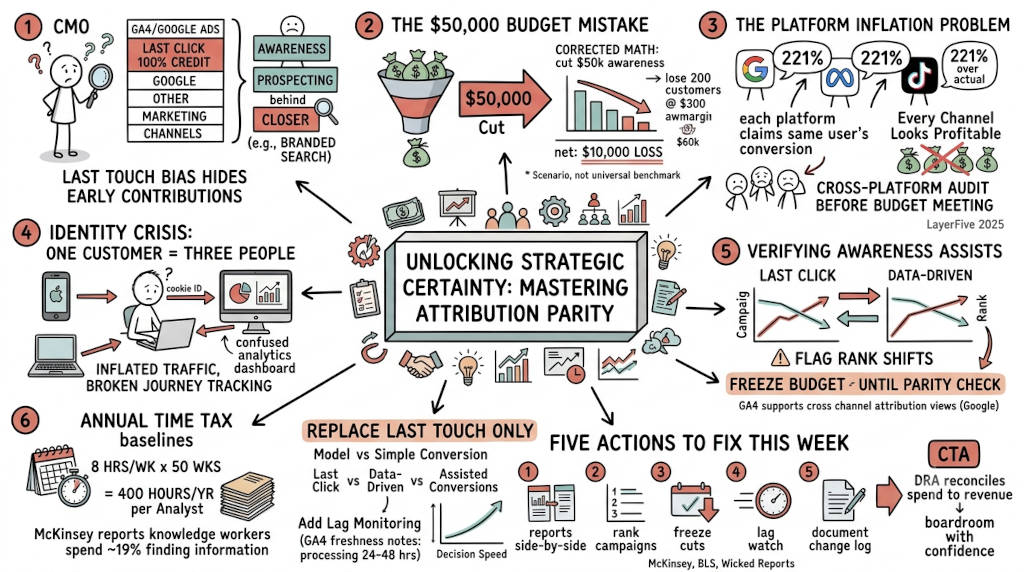
Summary: Last-touch attribution gives 100% of conversion credit to the final click, hiding the contribution of early-channel marketing like awareness and prospecting campaigns. This bias leads CMOs to cut top-funnel budget, which collapses pipeline volume weeks later. The real cost is not the spend saved but the margin lost. Fixing this requires attribution parity: running last-click and data-driven models side by side, flagging campaigns that shift rank, freezing cuts until a parity check is complete, and monitoring for GA4's 24-to-48-hour data processing lag. Every platform also inflates its own conversion credit. A unified view and a seven-day lag watch prevent budget decisions based on misleading single-model data.
Last touch gives full credit to the final click. Google states this directly. That model can hide early channel contribution. Teams then cut awareness spend too early. The fix is attribution parity. Compare models side by side. Add a lag check. Use transparent math before cutting budget. This rewrite corrects weak claims and keeps only defensible numbers.
1. What is last touch attribution bias?
The Answer: Last touch bias happens when one final interaction gets all conversion credit. Google Ads and GA4 both document this behavior for last click models (Google, n.d.-a; Google, n.d.-b). This can overvalue closers, like branded search, and undervalue starters, like awareness campaigns. The result is not just reporting bias. It becomes a budget allocation risk.
Why this matters for executive decisions
Google Ads states that last click gives all credit to the last clicked ad and keyword (Google, n.d.-a).
GA4 also defines paid and organic last click as 100 percent credit to the final channel before conversion (Google, n.d.-b; Google, n.d.-c).
If the board sees only that model, channel cuts can target the wrong budget line.
2. Why can last touch become a 50,000 dollar scale mistake?
The Answer: The 50,000 dollar mistake is a budgeting error pattern. It is not a universal benchmark. You cut 50,000 dollars from awareness because last touch shows weak direct conversions. Two weeks later, lower funnel volume drops. Your apparent savings become a pipeline loss. The mistake is not spend size. It is attribution blindness.
Corrected math with explicit assumptions
Use this scenario. Keep assumptions visible.
Awareness budget to cut: 50,000 dollars per month.
Blended contribution margin after media: 300 dollars per new customer.
Expected lost customers from reduced top funnel inputs: 200 in the next cycle.
Margin loss: 200 times 300 equals 60,000 dollars.
Net effect: you save 50,000 dollars in media but lose 60,000 dollars in margin.
Estimated net damage: 10,000 dollars for that cycle.
This is why the error scales quickly at larger budgets.
3. The hidden problem: every platform inflates its own credit
The Answer: Google Ads, Meta, and TikTok all claim overlapping conversions. Add up what each platform reports and you often get 150 to 300 percent of your actual conversions. This is not fraud. It is the result of each platform using its own attribution window, its own tracking method, and its own definition of a conversion.
Why this destroys budget decisions
A DTC brand spending 2 million dollars annually might see:
Google Ads claiming 450 conversions
Meta claiming 380 conversions
TikTok claiming 120 conversions
Actual conversions: 520
The platforms collectively claim 1,150 conversions. That is 221 percent of reality (LayerFive, 2025). Every channel looks profitable on paper. In reality, two or three channels are losing money. The CMO allocates more budget to channels that only appear to work because platform bias inflates their numbers.
The financial impact
For a company spending 100,000 dollars monthly on marketing, platform bias causes:
40,000 to 60,000 dollars attributed to the wrong channels
20,000 to 30,000 dollars in high-performing channels appearing to fail
15,000 to 25,000 dollars over-invested in channels taking false credit
Run a cross-platform audit before your next budget meeting.
4. The identity crisis: one customer looks like three
The Answer: The average consumer uses 3.2 devices daily (LayerFive, 2025). Each device generates a different cookie ID. Each browser generates a different cookie ID. If the same person uses Safari on an iPhone, Chrome on a work laptop, and Firefox on a home computer, your analytics platform sees three different people.
Two catastrophic effects
Inflated traffic numbers: Your analytics show 10,000 unique visitors. The real number is roughly 3,500 actual humans. Your conversion rate looks 2 to 3 times worse than it is.
Broken journey tracking: You cannot optimize a journey you cannot see. When the same person appears as multiple visitors, you have no idea that mobile Instagram ads created awareness, desktop display drove consideration, and email closed the sale.
The dollar cost
Companies without identity resolution typically:
Over-spend 20 to 40 percent on acquisition
Under-invest 30 to 50 percent in retention
Waste 15,000 to 45,000 dollars annually per 500,000 in spend
5. How do you verify whether awareness is actually assisting conversion?
The Answer: Use model comparison, not one model. Google Ads recommends comparing last click against data driven attribution to find undervalued campaigns and keywords (Google, n.d.-a). GA4 also supports cross channel attribution views (Google, n.d.-c). If rankings change across models, your spend decisions need a parity review before any cuts.
Practical verification workflow
Pull last click and data driven reports for the same date window.
Compare campaign rank shifts, not only total conversions.
Flag channels that drop hard under last click only.
Freeze budget cuts until the parity check is complete.
If a channel drives assisted paths, last touch will usually understate it.
6. How many hours can attribution cleanup consume each year?
The Answer: A conservative planning baseline is 400 hours per year per analyst for manual data work. The math is simple: 8 hours per week across 50 working weeks. McKinsey also reports knowledge workers spend about 19 percent of time finding information (McKinsey Global Institute, n.d.). Both signals support a material time tax before strategy work begins.
Consistent hours model across related DRA articles
Baseline formula: 8 hours times 50 weeks equals 400 hours yearly.
Team impact examples:
This keeps your hour model consistent with the revised Invisible Drain pieces.
7. What is the payroll value of those lost hours?
The Answer: Payroll impact depends on loaded hourly cost. Use a transparent range. At 60 dollars per hour, 400 hours cost 24,000 dollars. At 100 dollars per hour, 400 hours cost 40,000 dollars. For senior analysts, loaded cost can be higher. BLS shows benefits are a major share of employer compensation (U.S. Bureau of Labor Statistics, n.d.).
Corrected compensation framing
BLS reports private industry benefits at 29.9 percent of total compensation (U.S. Bureau of Labor Statistics, n.d.).
Conservative loaded estimate:
If base pay is 150,000 dollars and benefits plus taxes are about 30 percent of salary, loaded cost is about 195,000 dollars.
Share of total method using BLS split:
150,000 divided by 0.701 equals about 214,000 dollars total compensation equivalent.
Both methods show that base salary understates real cost.
8. What should replace last touch only reporting?
The Answer: Replace single model reporting with attribution parity controls. Keep one executive view. Include at least last click and data driven comparison. Add lag monitoring so you do not mistake delayed effects for channel failure. GA4 data freshness notes that processing can take 24 to 48 hours (Google, n.d.-d). Decision speed requires this context.
Minimum parity standard for weekly leadership reviews
Two model comparison table: last click and data driven.
Assisted conversion check for top funnel campaigns.
Seven day lag watch before major channel cuts.
Budget change log tied to conversion and margin outcomes.
This process reduces false negatives in awareness channels.
9. Five actions to fix last touch this week
The Answer: Stop analyzing. Start acting. These five steps move your team from single model blindness to attribution parity in five days.
Day 1: Pull both reports
Export last click and data driven reports from Google Ads. Export the equivalent from GA4. Put them side by side.
Day 2: Rank the gap
Sort campaigns by conversion volume under data driven. Compare rank against last click. The campaigns that shift down five or more positions are your misattribution candidates.
Day 3: Freeze cuts
Identify any awareness or prospecting campaign in the bottom 20 percent of last click reports. Freeze its budget for one week. Do not cut until you complete the parity review.
Day 4: Add a lag watch
Set a seven day hold on any channel cut decision. GA4 processing can take 24 to 48 hours. Attribution updates can change reported values after initial publication. Give the data time to settle.
Day 5: Document the change log
Create a budget change log. Record the model used, the date of the data pull, the margin assumption, and the actual outcome 30 days later. This log becomes your evidence base for future reallocations.
FAQ
Q: Is the 50,000 dollar mistake a proven industry average? A: No. It is a scenario amount. The pattern is real. The value depends on your margin and conversion volume.
Q: Should we remove last touch entirely? A: No. Keep it as one lens. Do not use it as the only budget authority.
Q: Why do report disagreements happen week to week? A: GA4 notes processing and attribution updates can change reported values after initial publication.
Q: Can we still use old position based models in GA4? A: No. Google states first click, linear, time decay, and position based models were deprecated.
Q: How do platforms inflate conversion credit? A: Each platform uses its own attribution window and tracking method. Adding up credits from Google, Meta, and TikTok often exceeds real conversions by 50 to 200 percent.
Q: What is the first operational step this week? A: Run a last click versus data driven comparison before your next budget reallocation.
CTA
Share this article with your marketing leadership team and run a last click versus data driven comparison before your next budget reallocation. Need to prove marketing ROI to your CEO? DRA reconciles spend to revenue so you walk into the boardroom with confidence.
References
Data Research Analysis. (2026). Unified marketing analytics platform. https://www.dataresearchanalysis.com/prove-roi-to-ceo
Google. (n.d.-a). About attribution models. Google Ads Help. https://support.google.com/google-ads/answer/6259715
Google. (n.d.-b). Get started with attribution. Google Analytics Help. https://support.google.com/analytics/answer/10596866
Google. (n.d.-c). Select attribution settings. Google Analytics Help. https://support.google.com/analytics/answer/10597962
Google. (n.d.-d). GA4 data freshness. Google Analytics Help. https://support.google.com/analytics/answer/11198161
LayerFive. (2025). Why 47% of your marketing budget is wasted (and how to fix it). https://layerfive.com/blog/stop-marketing-budget-waste/
McKinsey Global Institute. (n.d.). The social economy. McKinsey & Company. [Source URL no longer accessible — original reference: McKinsey Global Institute. The social economy]
U.S. Bureau of Labor Statistics. (n.d.). Employer costs for employee compensation. https://www.bls.gov/news.release/ecec.nr0.htm [Source URL returns access restriction — original reference preserved]
Wicked Reports. (2025). Stop wasting your marketing budget: Master attribution. https://www.wickedreports.com/blog/stop-wasting-your-marketing-budget-master-marketing-attribution