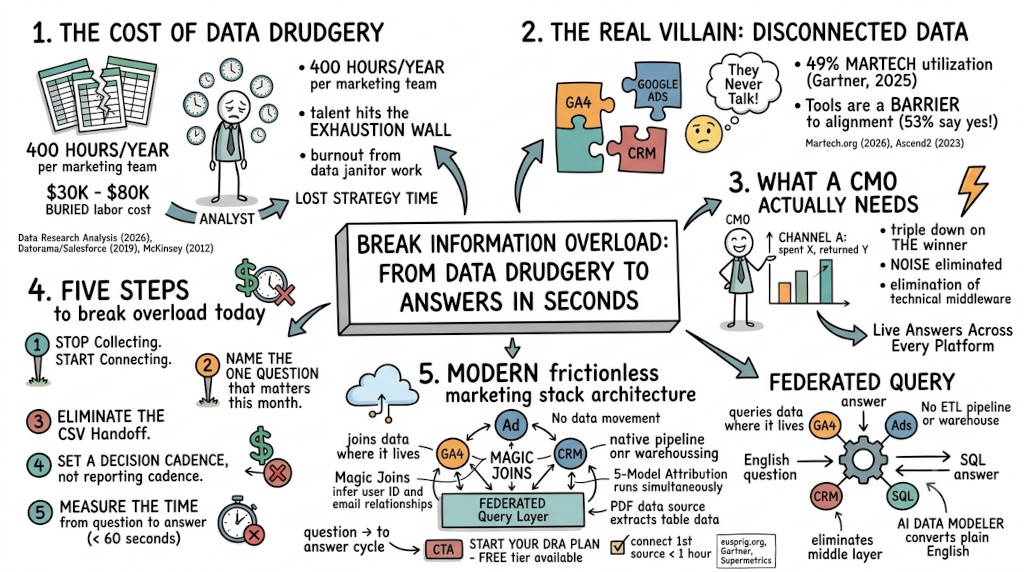
Summary: Information overload costs marketing teams 400 hours a year in manual data work and $30,000 to $80,000 in buried labor. The root cause is not too much data but disconnected data — GA4, ad platforms, and CRMs that never talk to each other. Adding more dashboards makes it worse. DRA's Federated Query Layer solves this by joining your data where it lives so your CMO can ask one question and get a live answer across every platform. This article breaks down the five steps to break information overload today and explains the architecture of a modern frictionless marketing stack.
Your marketing team pulls data from 6 platforms. Your CMO needs one answer. By the time you stitch the spreadsheets together, the board meeting is over. Information overload is not a data problem. It is a query problem. You do not need more dashboards. You need a single layer that joins your data where it lives — and answers questions in seconds, not days.
1. What is information overload costing your marketing team?
The Answer: 400 hours per year. That is what the average team spends on manual data maintenance — pulling CSV exports, reconciling Google Ads against GA4 against CRM, and rebuilding broken spreadsheet formulas (Data Research Analysis, 2026; Datorama/Salesforce, 2019; McKinsey Global Institute, 2012). At a blended loaded cost of $75/hour, that is $30,000 in pure labor. At a marketing director's rate, it is $80,000. This is not just a budget problem. It is how talent hits the Exhaustion Wall — burnout caused by data drudgery, not workload.
The hidden cost is worse. Every hour spent on data janitor work is an hour not spent on strategy. Your competitor who automated their query layer is testing new creative, reallocating budget, and moving faster. You are still aligning pivot tables.
The real villain: data where you cannot reach it
Your data is not lost. It is locked. Google Analytics keeps session data. Google Ads keeps campaign data. Your CRM keeps lead-stage data. They never talk to each other unless you manually connect them. That manual connection is where information overload lives.
2. Why more dashboards make the problem worse
The Answer: 53% of marketing leaders say their tools are a barrier to alignment, not an enabler (Martech.org, 2026; Ascend2, 2023). Every new dashboard adds another view of the truth. The paid ads dashboard says cost-per-lead is $47. The CRM says $68. Google Analytics says $53. Which number does your CMO report to the board?
They schedule another meeting. That is the real cost of information overload: decisions that never happen.
The dashboard trap
Most dashboards are static. They show what happened last week. By the time you see a performance drop, the campaign has been under-optimized for 48 hours. Gartner (2025) reports marketing technology utilization has dropped to 49%, meaning teams own the tools but cannot use them effectively. Competitors with real-time visibility pivoted yesterday. You are catching up to last week's news.
3. What does a CMO actually need from their data?
The Answer: Three numbers. Channel A spent X and returned Y. Channel B spent X and returned Y. Which one do I triple down on? That is the only question a CMO needs answered. Everything else is noise.
The problem is not that you lack data. You have more data than 2020 by 230% (Supermetrics, 2025). The problem is that you cannot ask this single question without a data engineer writing SQL for three days.
The Federated Query answer
DRA's Federated Query Layer joins GA4, Google Ads, and your CRM data where it lives. No ETL pipeline. No CSV export. No "data warehouse" project that takes six months. You write one English question. The AI Data Modeler translates it to SQL. The answer comes back in seconds.
This is not a faster dashboard. This is the elimination of the middleware layer between your question and your answer.
4. Five steps to break information overload today
The Answer: You do not need a six-month data transformation. You need five tactical moves that a CMO can execute this quarter.
Step 1: Stop collecting. Start connecting. Every data source you add without a query layer is another spreadsheet to reconcile. Freeze new tool purchases until you can query what you already own.
Step 2: Name the one question that matters this month. Ask your CEO: "What is the single decision you need data to support in the next board meeting?" Build your query around that one question. Ignore everything else until it is answered.
Step 3: Eliminate the CSV handoff. Every CSV export between platforms is a source of error and delay. Replace the handoff with a live query. DRA's Public Share Links let your CMO see the live answer — no login, no download.
Step 4: Set a decision cadence, not a reporting cadence. If you review reports weekly, you do not need real-time data. If you reallocate budget daily, you do. Match your data freshness to your decision speed.
Step 5: Measure the time from question to answer. Track how long it takes from "I need to know X" to seeing X on a screen. If it is longer than 60 seconds, your information overload has a measurable cost. Reduce that time. Everything else follows.
5. The architecture of a modern frictionless marketing stack
The Answer: Federated querying. Not data consolidation. Not a warehouse. Not another ETL tool.
The modern stack is not a single platform that holds all your data. That approach failed because data moves faster than migration projects. The modern stack is a query layer that sits above your existing tools and answers questions across them without moving the data.
Why this changes the game
Magic Joins automatically infer relationships between user IDs and emails across platforms. 5-Model Attribution runs First-Touch, Last-Touch, Linear, Time-Decay, and U-Shaped models simultaneously — so you never argue over which attribution model is "correct." The PDF Data Source extracts table data from vendor price lists. No manual data entry.
The technology proves the claim: you do not need to move your data. You need to query it where it lives.
FAQ
Q: Do I need a data engineering team to set this up? A: No. DRA's no-code AI Data Modeler converts plain English questions into SQL. If you can type a question, you can query your data.
Q: How long does it take to connect my existing tools? A: Most teams connect their first three data sources in under an hour. No IT ticket required.
Q: What if my data lives in spreadsheets? A: DRA's PDF Data Source extracts structured data from static documents. Upload the price list or contract. The tables become queryable immediately.
Q: Will this replace my existing analytics tools? A: No. It queries them. GA4, Google Ads, HubSpot, Salesforce — DRA sits above them and joins their answers. Your team keeps their workflow. The query layer eliminates the manual reconciliation.
Q: Is my data secure? A: The Federated Query Layer reads data where it lives. It does not copy or store it. No data leaves your source systems.
CTA
Stop joining spreadsheets. Start getting answers. Start your DRA plan — free tier available. Connect your first data source in under an hour.
References
Ascend2. (2023). Marketing and sales alignment research study. https://ascend2.com/wp-content/uploads/2023/05/SharpSpring-Sales-Marketing-Alignment-2022.pdf
Data Research Analysis. (2026). The invisible drain: Is your marketing team losing 400 hours a year to data drudgery? https://www.dataresearchanalysis.com/articles/the-invisible-drain-is-your-marketing-team-losing-400-hours-a-year-to-data-drudgery
Datorama / Salesforce Marketing Cloud Intelligence. (2019). The hidden cost of manual data management in marketing.
European Spreadsheet Risks Interest Group. (n.d.). Research and best practice. https://eusprig.org/research-info/research-and-best-practice/
Gartner. (2025). 2025 CMO spend survey. https://www.gartner.com/en/newsroom/press-releases/2025-05-12-gartner-2025-cmo-spend-survey-reveals-marketing-budgets-have-flatlined-at-seven-percent-of-overall-company-revenue
Gartner. (2025). 2025 marketing technology survey. https://www.gartner.com/en/marketing/topics/marketing-technology
Martech.org. (2026, April 3). Martech stacks are holding back sales and marketing teams. https://martech.org/martech-stacks-are-holding-back-sales-and-marketing-teams/
McKinsey Global Institute. (2012). The social economy: Unlocking value and productivity through social technologies.
Panko, R. R. (2008). What we know about spreadsheet errors. Journal of Organizational and End User Computing. https://arxiv.org/pdf/1602.02601
Supermetrics. (2025). 2025 Marketing data report. https://supermetrics.com/marketing-data-report-2025