Summary: Proving data analysis ROI requires a clear formula, accurate attribution, and the right metrics. Most marketers cannot connect spend to revenue because their data lives in silos and their attribution is incomplete. The solution starts with a simple calculation: (value generated minus cost) divided by cost. Add a baseline, fix data quality, and stop reporting vanity metrics. A unified analytics platform eliminates manual reconciliation and surfaces the real number. Without it, teams waste 400 hours a year on data maintenance and report metrics the CFO ignores. This article covers the formula, common mistakes, how to report to leadership, and a 5-step action plan to prove your data ROI today.
What Is Data Analysis ROI and Why Should You Calculate It?
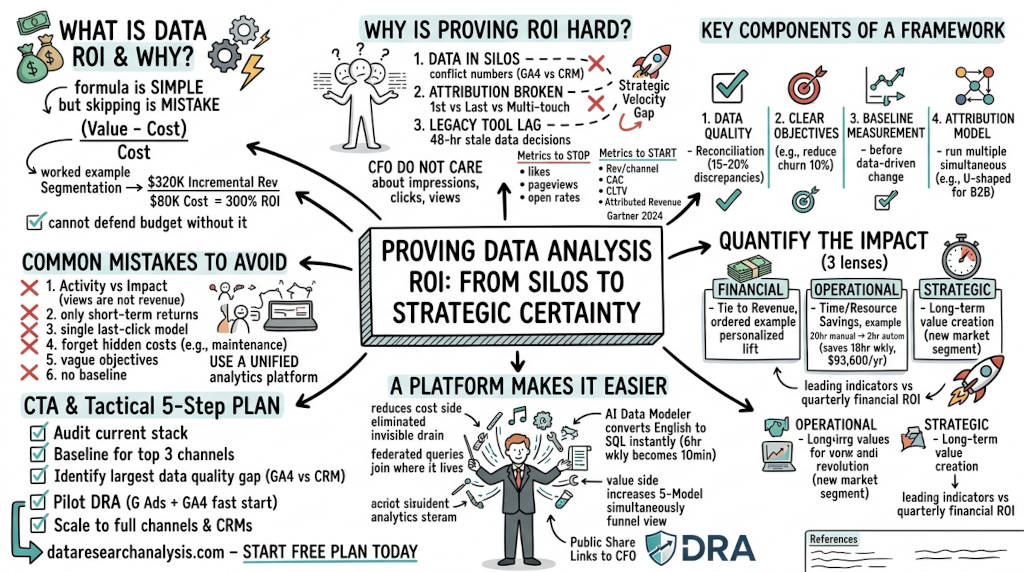
The Answer: Data analysis ROI is the financial return your company gets from every dollar spent on data tools, talent, and infrastructure. The formula is simple: (value generated from data minus cost of data initiatives) divided by cost of data initiatives. Most companies skip this calculation. That is a mistake.
Consider a retail business. Your data team builds a customer segmentation model. The model costs $80,000 to develop. It drives $320,000 in incremental revenue through better targeting. Your ROI is 300%. Without that number, you cannot defend your data budget. Without the budget, you cannot scale. (These figures are a hypothetical worked example for illustration.)
The Cost of Not Calculating
Every quarter your data ROI is unmeasured, you are approving tools, headcount, and infrastructure without knowing if they pay for themselves. The average enterprise spends $3.4 million annually on marketing analytics tools (Gartner, 2024). Fewer than 30% can prove the connection to revenue.
1. What Is the Formula for Data Analysis ROI?
The Answer: Data ROI = (Value Generated from Data minus Cost of Data Initiatives) divided by Cost of Data Initiatives.
Worked example: A B2B SaaS company invests $50,000 in a customer churn prediction model. The model helps retain $200,000 in annual recurring revenue. ROI = ($200,000 minus $50,000) divided by $50,000 = 300%.
The formula works at any scale. A $10,000 dashboard project or a $1 million data warehouse migration. The variables are the same. The precision depends on your ability to track outcomes back to the data initiative that caused them.
What to Include in the Cost Side
Most teams undercount. Include software licenses, engineering hours, training time, data storage, and compliance overhead. The Invisible Drain (CMO Crisis Pillar 5) swallows 400 hours a year per team on manual data maintenance (Data Research Analysis, 2026). Add that cost.
2. Why Is Proving Data ROI So Hard for Most Companies?
The Answer: Three interconnected problems block the calculation.
First, the data lives in silos. Google Ads tracks one version of a conversion. GA4 tracks another. Your CRM tracks a third. They conflict. Marketers cannot reconcile them without a unified query layer. This is the MarTech Stack Mess.
Second, attribution is broken. Last-click models give all credit to the final touchpoint. First-click models ignore nurturing. Multi-touch models require data integration most teams lack. Without accurate attribution, your ROI number is fiction.
Third, the tools themselves create lag. Legacy analytics platforms report what happened 48 hours ago. By then, the market has shifted. You are making decisions on stale data. This is the Strategic Velocity Gap.
The CFO Problem
Your CFO does not care about impressions, clicks, or dashboard views. They care about revenue, margin, and customer acquisition cost. The Nielsen 2024 Annual Marketing Report found that 70% of marketers plan to increase performance marketing spend while reducing brand-building investment (Nielsen, 2024). That is a direct gap between the tactics marketers use and the outcomes CFOs measure.
Metrics you should stop reporting to leadership: open rates, pageviews, social likes, dashboard logins (Wilson, 2024).
Metrics you should start reporting: revenue per channel, customer acquisition cost by source, customer lifetime value, marketing-attributed revenue.
3. What Are the Key Components of a Data Analysis ROI Framework?
The Answer: Four components must be in place before you calculate a single number.
Data Quality and Collection
Your ROI is only as good as your data. Garbage in, garbage out. Before measuring return, verify that your data sources are accurate, complete, and consistent across platforms. Data reconciliation alone can expose 15% to 20% discrepancies between GA4 and your CRM.
Clear Business Objectives
Define the specific KPI you are improving before starting any data initiative. "Increase sales" is not a target. "Reduce customer churn by 10% over two quarters" is. Every dollar of spend must connect to a measurable outcome.
Baseline Measurement
You cannot prove improvement without a starting point. Measure your chosen KPI for 30 to 60 days before launching any data-driven change. That baseline is your reference point for calculating ROI.
Attribution Model
Choose an attribution model that matches your sales cycle. First-touch works for long sales cycles. Last-click works for transactional purchases. U-shaped models work for B2B with multiple decision-makers. Using only one model hides half the story. Running five models simultaneously reveals the full picture.
4. How Do You Quantify the Impact of Data Analysis?
The Answer: Use three lenses: financial, operational, and strategic.
Financial impact: Can you directly tie a data insight to revenue or cost savings? If a personalized recommendation engine lifts average order value by 10%, that is measurable. If analysis reveals a $200,000 inefficiency in supply chain costs, that is measurable.
Operational impact: How much time or resources does your data initiative save? A report that took 20 hours per week to build manually and now takes 2 hours with automation saves 18 hours weekly. At $100 per hour for analyst time, that is $93,600 in annual savings.
Strategic impact: Harder to monetize in a single quarter, but critical. Data analysis that identifies a new market segment or reveals a competitive threat creates long-term value that does not show up in the first ROI calculation. Track it separately.
The Timing Question
"What if the ROI does not show up in three months?" This is the most common question from CEOs. Some data initiatives require 12 to 18 months to produce measurable return. Build a timeline into your ROI framework from day one. Report leading indicators monthly. Report financial ROI quarterly. The short-term versus long-term tension is real (Wilson, 2024). Acknowledge it. Plan for it.
5. What Makes a Data Analysis Platform Worth the Investment?
The Answer: The right platform reduces the cost side of the ROI equation while increasing the value side.
On the cost side: a platform like DRA eliminates the Invisible Drain. Federated queries join your GA4, SQL, and ads data where it lives: no data movement, no duplication, no manual export. The AI Data Modeler converts English questions into SQL instantly. What took 6 hours a week now takes 10 minutes.
On the value side: DRA's 5-Model Attribution runs first-touch, last-touch, linear, time-decay, and U-shaped models simultaneously. You see the full funnel in one view. Public share links let you send live dashboards to your CFO without login friction. They stop asking for spreadsheet exports. They start asking for strategy advice.
The Alternative
Consider the alternative: a manually stitched stack of GA4, a BI tool, a spreadsheet for attribution, and a weekly meeting to reconcile contradictions. That is the MarTech Stack Mess. It costs more than a unified platform. It returns less. And it burns your best talent on data janitor work instead of strategic analysis.
6. What Are the Most Common Mistakes in Measuring Data ROI?
The Answer: Six mistakes repeat across every industry.
Confusing activity with impact. Climbing dashboard views are not revenue.
Only measuring short-term returns. Brand-building and strategic analysis take longer.
Using last-click attribution as the only model. It overweights the final touchpoint.
Forgetting to include hidden costs: compliance, training, data maintenance.
Setting vague objectives before starting. "Improve marketing performance" guarantees nothing.
Failing to establish a baseline. Without it, you have no comparison point.
How to Avoid Them
Use a unified analytics platform that runs multiple attribution models, connects all your data sources, and generates automated ROI reports. Set clear KPIs before any initiative. Measure baseline performance for 30 days. Report financial and non-financial outcomes separately. Include hidden costs in every calculation.
7. What Is the Relationship Between Data Quality and ROI?
The Answer: Direct and proportional.
If your data quality scores 80%, your ROI calculation is at most 80% reliable. In practice, most organizations operate at 60% to 70% data accuracy across their marketing stack. That means every ROI number they produce has a 30% to 40% margin of error.
Five data quality checks to run before calculating ROI:
Do your GA4 numbers match your CRM numbers for the same period?
Are duplicate leads inflating your conversion count?
Are offline conversions tracked and attributed to the correct source?
Is your cost data pulled from the same source as your revenue data?
Are date ranges consistent across every platform?
A platform that performs data reconciliation automatically (like DRA's Magic Joins) catches these discrepancies before they corrupt your ROI number.
8. Does Data Analysis ROI Include Compliance and Security Costs?
The Answer: It must. Data governance, GDPR compliance, CCPA adherence, and security infrastructure can eat 15% to 20% of projected ROI if ignored.
Most ROI calculations show only the upside. They project the revenue gain and ignore the compliance overhead. That is not a real calculation. Factor in your data storage costs, your audit trail requirements, your consent management system, and the engineering time needed to maintain security certifications.
A platform with built-in governance controls (role-based access, audit logging, data lineage) reduces these costs because you are not stitching together separate compliance tools.
9. How Do You Report Data Analysis ROI to the C-Suite?
The Answer: Lead with the number that matters to each executive.
To the CFO: "This data initiative produces a 300% ROI over 18 months. Customer acquisition cost drops by 15%. The margin impact is $500,000 annually."
To the CEO: "We are gaining 2% market share in our core segment because our data-driven personalization program outperforms competitors on repeat purchase rate."
To the board: "We have reduced marketing spend waste by 22% through multi-touch attribution. Every channel now reports revenue per dollar spent. The data team is a profit center, not a cost center."
The Dashboard That Works
Stop sending PDF exports. Send a live link. DRA's Public Share Links let executives view real-time dashboards without creating accounts. They see revenue attributed by channel, customer acquisition cost trends, and ROI by initiative. When the board asks a question, you answer it from the live data, not last month's spreadsheet.
Tactical Next Steps: A 5-Step Action Plan
Audit your current data stack. List every platform collecting marketing data. Map which data sources connect to each other and which do not.
Establish baseline ROI for your top three channels. Measure revenue, cost, and attributed performance for 30 days using at least two attribution models.
Identify the largest data quality gap. Compare GA4 and CRM conversion numbers for the same period. Fix the discrepancy before investing in new tools.
Run a pilot with DRA. Connect two data sources (Google Ads and GA4 is the fastest start). Generate a unified ROI report. Compare it to your current manual process. Measure the time saved.
Scale the framework. Once the pilot proves ROI, expand to all channels. Add SQL databases and CRM data. Move from single-model to multi-model attribution.
FAQ
Q: What is the difference between data-driven and data-informed? A: Data-driven means decisions follow the data automatically. Data-informed means data is one input alongside experience and intuition. Most effective teams are data-informed.
Q: How long does it take to see ROI from a data analysis platform? A: Pilot projects show results in 30 to 60 days. Full enterprise ROI typically requires 6 to 12 months. Set expectations with leadership before starting.
Q: Should I calculate ROI for every data project? A: Yes, but at different levels of precision. A $10,000 dashboard project needs a rough calculation. A $500,000 data warehouse migration needs financial-grade precision with audited numbers.
Q: What is the biggest hidden cost in data analysis? A: Manual data maintenance. Teams waste an average of 400 hours per year reconciling data across platforms. That is $40,000 to $60,000 in analyst time that adds zero strategic value.
Q: Which attribution model is best for B2B? A: U-shaped or time-decay models. B2B sales cycles involve multiple touchpoints over months. Last-click ignores the first three interactions that built the pipeline.
Q: Can I prove data analysis ROI without a unified platform? A: You can, but the calculation takes 3 to 5 times longer and has a higher error rate. Every manual export introduces a reconciliation step. Every reconciliation step risks data corruption. To prove marketing ROI with confidence, a unified platform eliminates manual reconciliation at every step.
CTA
Stop guessing your data ROI. Connect your stack and see the real number. Start your DRA plan today
References
Data Research Analysis. (2026). The 7 pillars of the CMO crisis: Pillar 5 — the invisible drain. Data Research Analysis. https://www.dataresearchanalysis.com/articles
Data Research Analysis. (n.d.). Prove marketing ROI: Connect your spend to revenue. Data Research Analysis. https://www.dataresearchanalysis.com/prove-marketing-roi
Gartner. (2024). Marketing technology survey 2024: Budgets, stacks, and spending trends. https://www.gartner.com/en/marketing/research/marketing-technology-survey
Nielsen. (2024, May). 2024 Annual marketing report: Maximizing ROI in a fragmented world. https://www.nielsen.com/insights/2024/maximizing-roi-in-a-fragmented-world-nielsen-annual-marketing-report/
Wilson, T. (2024, May). 'Data driven' is no longer enough for your ROI strategy. Nielsen. https://www.nielsen.com/insights/2024/data-driven-not-enough-roi-strategy-marketing-metrics-business-impact/