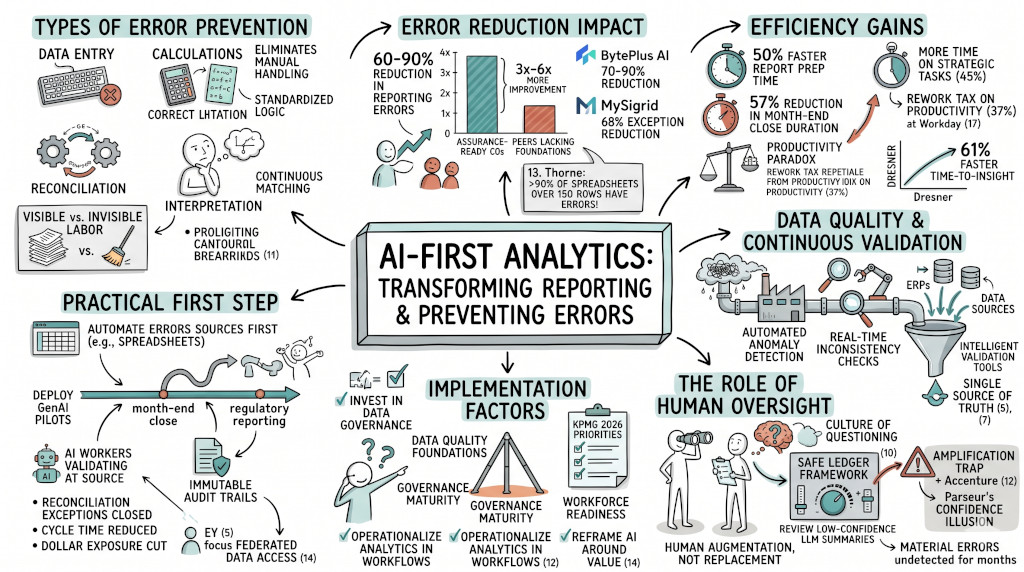
Summary: AI-first analytics fundamentally transforms reporting by eliminating manual data handling, providing automated validation, and creating trusted single sources of truth. Organizations implementing AI-first approaches report 60-90% reductions in reporting errors while cutting preparation time by half. However, success requires assurance-ready practices including governance, human oversight, and data quality foundations—without which AI can amplify rather than prevent errors.
1. What specific types of human error does AI-first analytics prevent in reporting?
The Answer: AI-first analytics prevents errors across the entire reporting lifecycle: data entry mistakes (eliminated through automation), calculation errors (prevented by standardized logic), reconciliation failures (solved via continuous matching), and interpretation errors (reduced through contextual explanations). It specifically targets the "invisible labor" of reporting—hours spent copying, pasting, and double-checking formulas that introduce costly mistakes.
The Error Spectrum in Manual Reporting
Manual reporting creates multiple error opportunities: transcription errors when moving data between systems, formula mistakes in spreadsheets, version control issues when multiple analysts work on files, and reconciliation gaps between source systems. Research shows 90% of spreadsheets with over 150 rows contain at least one major mistake (Thorne, 2024). AI-first approaches eliminate these by automating data collection from ERPs, spreadsheets, and external sources while applying deterministic validation rules (EY, 2025).
2. How much do organizations actually reduce reporting errors with AI-first analytics?
The Answer: Organizations implementing AI-first analytics report 60-90% reductions in reporting errors, with assurance-ready companies seeing 3-6x greater improvement than those without proper governance (KPMG, 2026a). BytePlus AI Automation users specifically report 70-90% reduction in reporting errors (BytePlus, 2026), while MySigrid framework implementations achieve 68% average reduction in monthly reconciliation exceptions and 82% cut in identified-dollar exposure to reporting errors (MySigrid, n.d.).
The Assurance Readiness Advantage
KPMG's 2026 Global AI in Finance survey reveals a critical distinction: assurance-ready organizations (those with strong controls, governance, and auditability) report 33% significant improvement in error reduction compared to just 6% for peers lacking these foundations—representing three to six times higher error reduction rates (KPMG, 2026b). This demonstrates that AI's error prevention capability is maximized when paired with proper governance frameworks.
3. What measurable efficiency gains accompany error reduction in AI-first reporting?
The Answer: AI-first analytics delivers dual benefits: error reduction and efficiency gains. Organizations report 50% faster report preparation time (BytePlus, 2026), 57% reduction in month-end close duration (MySigrid, n.d.), and 45% more time spent on high-value strategic tasks rather than data manipulation (EY, 2025). Dresner Advisory Services found 61% of organizations using AI-driven reporting experience significantly faster time-to-insight (Futuretoolkit.ai, 2025).
The Productivity Paradox
However, efficiency gains require careful measurement. Workday's research reveals that 37% of time saved using AI tools is lost to "rework"—correcting, clarifying, or rewriting low-quality AI-generated content (Workday, 2026). This "AI tax on productivity" underscores that error prevention depends not just on automation but on proper output validation and human-in-the-loop processes.
4. How does AI-first analytics improve data quality beyond error prevention?
The Answer: AI-first analytics improves data quality through continuous validation, automated anomaly detection, and enforced standardization. Machine learning algorithms detect inconsistencies in real-time, intelligent validation tools cross-check figures across sources, and AI applies tested calculation logic universally—eliminating the "garbage in, garbage out" problem (Daloopa, 2024; IBM, n.d.).
From Detection to Prevention
Unlike traditional approaches that catch errors post-facto, AI-first systems prevent errors at the point of data ingestion. For example, AI-powered reconciliation engines instantly match transactions across systems, flagging discrepancies before they post to consolidated ledgers (Future Coworker, 2025).
5. What role does human oversight play in AI-first error prevention?
The Answer: Human oversight is essential for effective error prevention—AI augments rather than replaces human judgment. Organizations blending AI with a culture of questioning outperform rivals on innovation metrics (Future Coworker, 2025). MySigrid's SAFE Ledger Framework requires human sign-off for automated adjustments above dollar thresholds and flags low-confidence LLM summaries for review (MySigrid, n.d.).
Avoiding the Amplification Trap
Without oversight, AI can amplify errors. Accenture found nearly 20% of organizations discovered material errors in AI-generated reports that went undetected for months (KPMG, 2026a). The Parseur survey highlights this risk: 88% of professionals report finding errors in document-derived data despite confidence in AI systems, revealing a dangerous "confidence illusion" (Parseur, 2026). Effective AI-first analytics combines automation with human validation—using specialized AI grounded in reference data, enforcing strict validation rules, and providing seamless review pathways when confidence is low.
6. What implementation factors determine whether AI-first analytics prevents or creates reporting errors?
The Answer: Success depends on three factors: data quality foundations, governance maturity, and workforce readiness. KPMG identifies data quality as both the biggest barrier and opportunity for 36% of organizations (IBM, n.d.). Workiva reports 79% of companies prioritize data automation and governance to close enterprise-wide gaps (Workiva, 2026). Crucially, Sisense found 65% of teams still make decisions without referencing available data—not due to AI failure but because analytics aren't operationalized in decision workflows (Sisense, 2026).
The Assurance Readiness Framework
Organizations getting AI-first analytics right treat it as a catalyst for cultural change rather than a silver bullet. They invest in data governance, transparent models, and ongoing human oversight—approaches that yield measurable ROI (KPMG, 2026a). KPMG's four priorities for 2026 capture this: reframe AI around value not tasks, treat governance as the ticket to play, build measurement into execution, and shape the total workforce—not just training (IBM, n.d.).
7. What is the first practical step toward implementing AI-first error prevention in reporting?
The Answer: Begin by automating data collection and validation from your most error-prone sources—typically spreadsheets and manual reconciliation processes. EY found that deploying GenAI for automated data collection from multiple sources, natural language queries, and anomaly detection reduced manual workload by 60% while significantly improving accuracy (EY, 2025). Focus on creating a single source of truth through federated data access that connects to existing systems without requiring migration.
From Pilots to Prevention
Start with a high-impact use case like month-end close or regulatory reporting where manual errors carry significant risk. Implement AI Workers that validate figures at the source, create immutable audit trails with evidence, and escalate only true exceptions requiring human judgment (Future Coworker, 2025). Measure success through concrete KPIs: reconciliation exceptions closed, month-end cycle time reduced, and dollar exposure to reporting errors cut—then scale based on proven results.
References
Futuretoolkit.ai. (2025, February 8). Automated business report generation and the end of manual BI. https://futuretoolkit.ai/automated-business-report-generation
BytePlus AI Automation eliminates manual reporting errors. (2026, February 16). AITropolis. https://aitropolis.com/eliminating-manual-reporting-errors-with-byteplus-ai-automation/
Workday. (2026). Almost half of the time saved using AI is spent correcting outputs. CFO.com. https://www.cfo.com/news/almost-half-of-time-saved-using-ai-is-spent-correcting-outputs-cfo-ai-use-errors-workday-report-/810018/
Daloopa. (2024, September 9). How AI is transforming earnings report processing in 2025. https://daloopa.com/blog/analyst-best-practices/how-ai-is-transforming-earnings-report-processing-in-2025
EY. (2025, June 19). How AI is transforming FP&A. https://www.ey.com/content/dam/ey-unified-site/ey-com/en-gl/services/consulting/documents/ey-gl-how-ai-is-transforming-fpa-06-2025.pdf
Future Coworker. (2025, June 12). AI-enabled enterprise reporting: 7 hard truths for 2026 executives. https://futurecoworker.ai/ai-enabled-enterprise-reporting
IBM. (n.d.). AI in financial reporting. https://www.ibm.com/think/topics/ai-in-financial-reporting
KPMG. (2026a, May 1). AI adoption in finance doubles, but assurance readiness determines who wins. https://kpmg.com/xx/en/media/press-releases/2026/05/ai-adoption-in-finance-doubles-but-assurance-readiness-determines-who-wins.html
KPMG. (2026b, May 12). KPMG global AI in finance report. https://kpmg.com/th/en/insights/2026/05/kpmg-global-ai-in-finance-report.html
MySigrid. (n.d.). How AI reduces errors in financial reporting: A practical framework. https://www.mysigrid.com/ai-accelerator-blog/how-ai-reduces-errors-in-financial-reporting-a-practical-framework
Parseur. (2026, January 13). 88% report errors in data feeding AI (Parseur Survey 2026). https://parseur.com/blog/data-confidence-gap
Sisense. (2026, April 30). Sisense explains operationalizing AI insights and shifting to embedded analytics. https://www.sisense.com/reports/state-of-analytics-2026/
Thorne, S. (2024, January 25). Spreadsheet errors can have disastrous consequences – yet we keep making the same mistakes. The Conversation. https://theconversation.com/spreadsheet-errors-can-have-disastrous-consequences-yet-we-keep-making-the-same-mistakes-219356
Workiva. (2026, February 2). Workiva executive benchmark survey finds instability is accelerating data automation and governance in 2026. https://newsroom.workiva.com/press-releases/workiva-executive-benchmark-survey-finds-instability-accelerating-data-automation