Summary: CMOs lose 10 hours a week to manual data plumbing — CSV exports, VLOOKUPs, broken joins — across five disconnected platforms. AI-first automation fails when you automate the report before structuring the data. The fix is a three-layer architecture: define the data model, build monitored pipelines, then let AI generate reports. DRA connects every source in one click, refreshes data in real time, answers questions in plain English, and proves ROI with numbers that match the bank account. It replaces five tools with one platform and stops the drudgery that burns out your best talent.
Your team burns 400 hours a year fixing data that should move itself. Every hour lost to manual reporting is an hour your competitor uses to reallocate spend, test creative, and capture the market you are still analyzing. This is not a skills problem. It is a plumbing problem.
1. What is the invisible drain in marketing reporting?
The Answer: The invisible drain is the collection of manual data tasks your team repeats every reporting cycle. Exporting CSV files from five platforms. Fixing channel naming mismatches. Patching broken joins between GA4 and your CRM. These tasks do not look strategic. That is why they survive quarter after quarter.
Where does the time actually go?
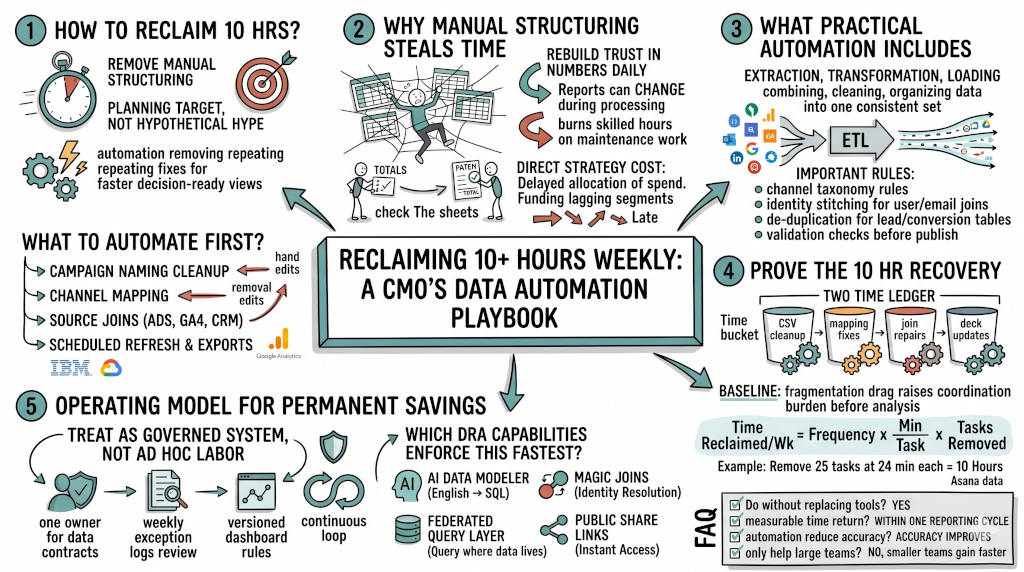
Marketing teams lose hours to four repeating tasks: extraction, cleaning, joining, and publishing. Google confirms data processing can take 24 to 48 hours. During that window, reports change. Teams recheck totals. They patch spreadsheets. The work looks small individually. Together, it steals 10 hours a week from a mid-size marketing team (Google, n.d.).
2. Why does AI-first reporting automation fail?
The Answer: Most teams try to automate the report before they structure the data. AI tools can only process what they can read. When the underlying data is inconsistent, siloed, or manually curated, the automation produces output no one trusts. Garbage in, garbage out.
The two failure patterns every CMO should recognize
Tool-first thinking. You buy a dashboard tool or a connected BI platform. The tool produces reports faster. But the reports are still reading from raw, unreconciled exports. The automation inherits the mess. Your team spends as much time verifying the output as they did building the manual report.
Workflow-free automation. You deploy AI commentary or automated slide builders. But there is no data model specifying which metric comes from which source. No rule for what counts as a conversion. The AI generates confident-sounding analysis from inconsistent numbers. Your team loses trust. The tool gets abandoned by month three.
Organizations that link AI to structured workflows report 2 to 3 times higher value from AI initiatives than those that deploy AI on unstructured data (Singla et al., 2025).
3. What does automated data structuring include in practical terms?
The Answer: Automated structuring means your pipeline handles extraction, transformation, and loading on a defined schedule. IBM defines ETL as combining, cleaning, and organizing data into one consistent set. Modern ETL tools automate the entire flow. Your team reviews the output. They do not build it (IBM, n.d.).
Which rules matter most for marketing reporting accuracy?
Use strict channel taxonomy rules. Add identity stitching for user and email joins. Add de-duplication rules for lead and conversion tables. Add validation checks before dashboard publish. These four rules protect decision speed and executive trust.
4. What should the reporting automation architecture look like?
The Answer: The architecture has three layers. Build them in sequence. Skip a layer and the automation fails.
A three-layer framework that lasts
Layer 1: Data Definition. Before any pipeline is built, define a reporting data model. Specify: which metrics are reported, how each is calculated, which platform is the source of truth, the reporting cadence, and acceptable variance thresholds. Document this in a structured format. Version-control it.
Layer 2: Data Pipelines. Pull data from each source on the defined cadence. Apply agreed calculations. Deposit normalized output into a central store. Monitor the pipelines. A broken pipeline that silently fails is worse than no pipeline.
Layer 3: Report Generation. With a reliable data store feeding it, AI-assisted reporting works. Commentary generates from metric changes. Slides auto-populate from templates. Anomalies flag before the account manager reviews the draft.
Before vs after: what changes
Task | Manual | Automated |
|---|---|---|
Data extraction | 2 to 3 hours | 10 to 15 minutes |
Cleaning and joining | 2 to 3 hours | 20 to 30 minutes |
Report building | 2 to 3 hours | 20 to 30 minutes |
Executive export | 30 minutes | Automated |
5. What does the time recovery actually look like for a marketing team?
The Answer: A marketing team of 10 people generates manual reporting tasks across at least 5 platforms. A typical team can remove 25 repeating tasks at 24 minutes each per week. That recovers 10 hours. The formula is simple: frequency × minutes per task × tasks removed.
How do you prove the recovery to leadership?
Run a two-week time ledger. Track every recurring manual task: CSV cleanup, mapping fixes, join repairs, deck updates. Automate one bucket at a time. Remeasure. Present hours returned to planning and optimization work. Keep the ledger visible in weekly leadership reviews.
What baseline anchors the urgency?
Asana reports leaders lose 3.6 hours weekly to unnecessary meetings. Workers use 62 apps daily. Fragmentation raises coordination drag before analysis even begins. Automated structuring reduces this switching burden inside reporting workflows (Asana, 2023).
6. What keeps the time savings permanent?
The Answer: Treat data structuring as a governed system. Not ad hoc analyst labor. Define one owner for data contracts and mapping standards. Review exception logs weekly. Ship dashboard updates through versioned rules. This model prevents regression into spreadsheet firefighting.
Which DRA capabilities enforce that model fastest?
Use AI Data Modeler for English-to-SQL generation so analysts spend zero time writing queries. Use Magic Joins for identity resolution across user IDs and emails. Use the Federated Query Layer to query data where it lives — no exports required. Use Public Share Links for instant executive access without login friction. These four capabilities remove the translation work that creates the weekly drain (Data Research Analysis, 2026a).
7. Beyond reporting: what else does DRA solve while you reclaim your 10 hours?
The Answer: Reporting automation recovers time. But the same platform that structures your data also closes five other drains that cost CMOs budget, trust, speed, talent, and sanity. DRA is a marketing intelligence platform. Fixing reporting is just where the savings start.
Close the Strategic Velocity Gap
Legacy tools carry a 48-hour reporting lag. By the time you see the numbers, competitors have already reallocated budget. DRA refreshes data in real time. Live KPI cards update as your sources change. AI-powered alerts fire the moment a metric crosses your threshold. You stop reacting to two-day-old data and start pivoting the moment a channel underperforms (Data Research Analysis, 2026b). The 48-hour blind spot is the difference between catching a trend and chasing one. DRA gives you the fast data your competitors are already using. Strategic velocity is not a luxury. It is survival.
Prove ROI to the CFO
Your dashboard shows green arrows. The bank account shows flat revenue. That gap erodes trust at the boardroom table. DRA unifies spend, conversion, and revenue data from every source into one Truth Layer. The numbers in your dashboard match the numbers in the P&L. CEO-ready reports surface CAC, LTV, payback period, and marketing-attributed revenue — the metrics your CFO actually cares about. Walk into every board meeting with a single source of truth that reconciles (Data Research Analysis, 2026b, 2026c). When your dashboard matches the bank account, budget conversations become investment conversations.
Replace Your MarTech Stack Mess
53% of marketing leaders say their own tools block alignment (Data Research Analysis, 2026b). You pay for five or more tools that do not talk to each other — Google Ads, GA4, LinkedIn, Meta, your CRM, and a collection of spreadsheets. DRA connects them all with OAuth in one click. The Federated Query Layer lets you join data across every source as if it were one database. One platform replaces your analytics tool, attribution tool, reporting tool, data connector, and dashboard builder. One bill. One source of truth. No more exporting and stitching data across ten tabs (Data Research Analysis, 2026d).
Escape the Technical Translation Trap
CMOs spend 10 hours a week on technical troubleshooting — broken dashboards, expired API keys, data connections that went dark. Your team files a ticket instead of asking a question. DRA eliminates the SQL bottleneck. Ask your data questions in plain English. "Why did conversions drop last week?" Get an instant answer with supporting data. No query, no ticket, no wait. Build dashboards with drag and drop. No code required. The AI Data Modeler handles the technical work. You handle strategy (Data Research Analysis, 2026e).
Stop the Talent Exhaustion Wall
Your best people did not join marketing to become spreadsheet operators. When 80% of their time goes to manual data tasks — VLOOKUPs, CSV exports, broken dashboard fixes — they leave. Replacing a burned-out marketing hire costs 150% of their annual salary (Data Research Analysis, 2026f). DRA automates the drudgery so your team does the work they were hired for: campaign optimization, audience analysis, creative testing. Auto-refreshing dashboards mean no Monday morning rebuilds. Team collaboration means everyone works from the same truth layer. Your talent stays because their work matters again.
8. FAQ
Q: Can we do this without replacing every existing tool? A: Yes. Federation and automation layer on top of current systems. You keep your stack. DRA reads from it.
Q: How long until leadership sees measurable time return? A: Most teams see clear change within one reporting cycle — typically two to four weeks.
Q: Will automation reduce reporting accuracy? A: Accuracy improves when rules replace manual formatting steps. Validation checks catch discrepancies before the report ships.
Q: Does this only help large teams? A: No. Smaller teams gain faster because capacity is tighter. A five-person team losing 10 hours weekly to reporting has lost 25 percent of its total capacity.
Q: What does this cost if we do nothing? A: At a conservative $40 per hour per team member, 10 hours weekly across a 10-person team equals $400 per week. That is $1,600 per month. Over a year, $19,200. The cost of inaction is a junior salary — burned on data plumbing.
Q: How do I sell this to my CFO? A: Frame it as margin recovery. Manual reporting is non-billable labor. Automation converts that labor cost into strategic output without adding headcount.
The reporting drain closes when you stop treating data as a project and start treating it as a utility. Start your plan on DRA and get your first time ledger running this week.
References
Google. (n.d.). [GA4] Data freshness. Google Analytics Help. https://support.google.com/analytics/answer/11198161
Singla, A., Sukharevsky, A., Yee, L., Chui, M., & Hall, B. (2025, March 12). The state of AI: How organizations are rewiring to capture value. McKinsey & Company. https://www.mckinsey.com/capabilities/quantumblack/our-insights/the-state-of-ai-how-organizations-are-rewiring-to-capture-value
IBM. (n.d.). What is ETL (extract, transform, load)? IBM Think. https://www.ibm.com/think/topics/etl
Asana. (2023). The anatomy of work global index. https://asana.com/resources/anatomy-of-work
Data Research Analysis. (2026a). The invisible drain: Stop wasting 400 hours on manual data work. https://www.dataresearchanalysis.com/invisible-drain
Data Research Analysis. (2026b). How to prove marketing ROI to your CEO & CFO. https://www.dataresearchanalysis.com/prove-roi-to-ceo
Data Research Analysis. (2026c). Prove marketing ROI: Connect your spend to revenue. https://www.dataresearchanalysis.com/prove-marketing-roi
Data Research Analysis. (2026d). Connect marketing spend to revenue: End the MarTech stack mess. https://www.dataresearchanalysis.com/connect-marketing-spend-to-revenue
Data Research Analysis. (2026e). The technical translation trap: Stop being IT support for dashboards. https://www.dataresearchanalysis.com/technical-translation-trap
Data Research Analysis. (2026f). The exhaustion wall: Marketing burnout caused by data drudgery. https://www.dataresearchanalysis.com/exhaustion-wall