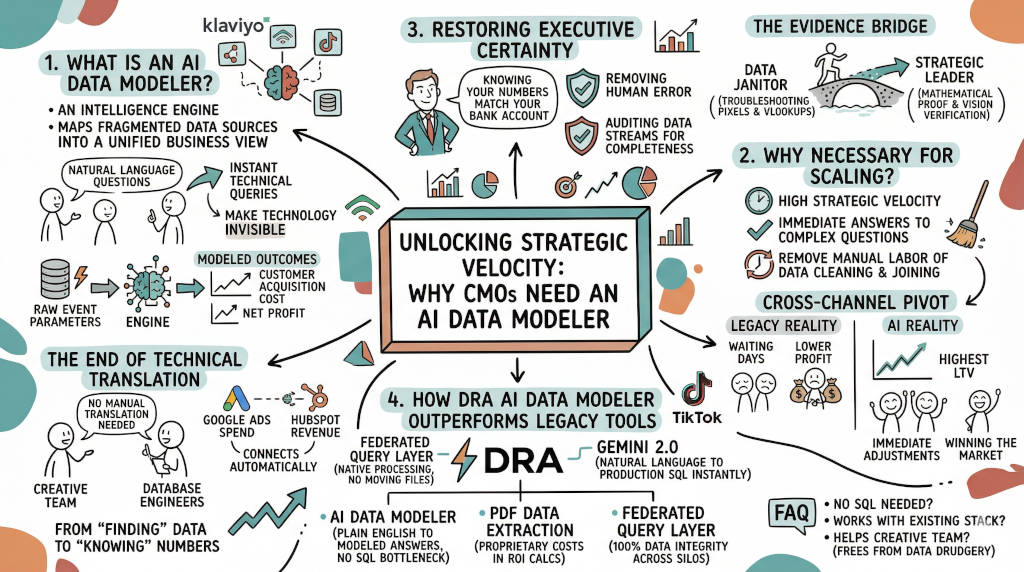
Every morning you spend translating dashboard charts into boardroom decisions is a morning your competitor spent acting. The 48-hour report lag in tools like GA4 forces you to lead from the rearview mirror. You do not need more charts. You need answers. An AI analytics platform for CMOs turns raw marketing data into modeled business answers without requiring a data engineer. This report identifies how to stop watching charts and start leading with factual certainty.
1. Why is an AI analytics platform for CMOs necessary for scaling?
The Answer: An AI analytics platform for CMOs is a system that turns raw marketing data into modeled business answers without SQL. It connects your ad platforms, CRM, and revenue data into a single truth layer. You ask questions in plain English. The engine generates the query, runs the math, and returns the answer in seconds. For a mid-market CMO, this removes the data engineering bottleneck from every strategic decision.
The cost of manual data aggregation
Your marketing team spends an average of 15 hours per week on manual data aggregation and reporting (HubSpot, 2025). That is almost two full workdays per team dedicated to pulling data from disparate sources. For a team of five with a loaded cost of $85 per hour, that is $63,750 per year spent on data drudgery instead of strategy. This is the invisible drain identified as Pillar 5 of the CMO Crisis.
How this is not another dashboard
Tableau, Looker, and Power BI require a human to structure the data before any question can be answered. An AI analytics platform models the data for you. It understands that "CAC by channel last quarter" means joining your ad spend table with your HubSpot deals table. You skip the data modeling step entirely. Gartner's 2025 CMO Spend Survey found that 59% of CMOs report insufficient budget to execute their strategy (Gartner, 2025). The report lag from traditional tools compounds this constraint.
2. How is an AI analytics platform different from the tools you already own?
The Answer: Your current stack was built for analysts, not executives. GA4 shows event counts. Tableau shows charts. Neither answers "which channel drove the highest net profit after agency fees?" An AI analytics platform closes this gap. It performs the joins, applies the filters, and runs the math your data team would spend three days building.
Tool Type | What It Does | Who It Serves | Time to Answer |
|---|---|---|---|
BI Tool (Tableau/Looker) | Visualizes prepared data | Analysts | 2-5 days per new question |
CDP (Segment/mParticle) | Unifies customer profiles | Ops teams | Pre-built, inflexible |
AI Analytics Platform | Answers any business question | Executives | 30 seconds |
The mid-market advantage
Mid-market teams cannot afford a dedicated data engineer. An AI analytics platform replaces the need for one. Your marketing ops lead stops writing SQL. They start building strategy. Only 28% of CMOs feel their martech stack fully supports their strategic goals (CMO News Desk, 2026). For the remaining 72%, the gap is not tool count. It is tool design.
3. What does the Technical Translation Trap cost your team?
The Answer: The Technical Translation Trap is Pillar 6 of the CMO Crisis. It is the hidden cost of having humans translate business questions into technical queries. McKinsey research shows that companies with a single integrated customer-facing executive in the C-suite see up to 2.3 times more growth than those with fragmented roles (Bettati et al., 2025). The cost of fragmentation starts at the data layer. When your CMO cannot ask a direct question and get a direct answer, strategic velocity collapses.
The invisible drain
Every time your marketing manager asks "can you pull last month's ROAS by campaign?" and waits 48 hours for a response, your competitor has already reallocated budget. The lag is not a data problem. It is a leadership problem. Marketing departments report up to a 20% discrepancy in ROI figures across different internal teams due to a lack of standardized reporting frameworks (IAB, 2026). An AI analytics platform removes this discrepancy by providing a single truth layer every query runs against.
If you are still translating between your team and your data, you are in The Technical Translation Trap. Read how to escape it.
4. How does the DRA AI Data Modeler solve this?
The Answer: The Data Research Analysis AI Data Modeler uses Gemini 2.0 to convert your plain English questions into production-grade SQL instantly. It connects to HubSpot, Klaviyo, TikTok, Google Ads, and your data warehouse through a Federated Query Layer. Your data stays where it lives. No ETL. No migration. No data engineer required.
What this means for your Monday morning
You walk into the boardroom. The CEO asks: "What was our true blended CAC last month including agency fees from two vendors?" You open your DRA dashboard. You answer in 30 seconds. Your CFO verifies the number against the bank account. It matches. You move on to strategy. That is executive certainty.
The Gartner 2026 CMO Spend Survey found that CMOs are allocating an average of 15.3% of marketing budgets to AI initiatives, yet only 30% report mature AI readiness capabilities (Gartner, 2026). The barrier is not willingness to invest. It is data foundations that cannot support the investment.
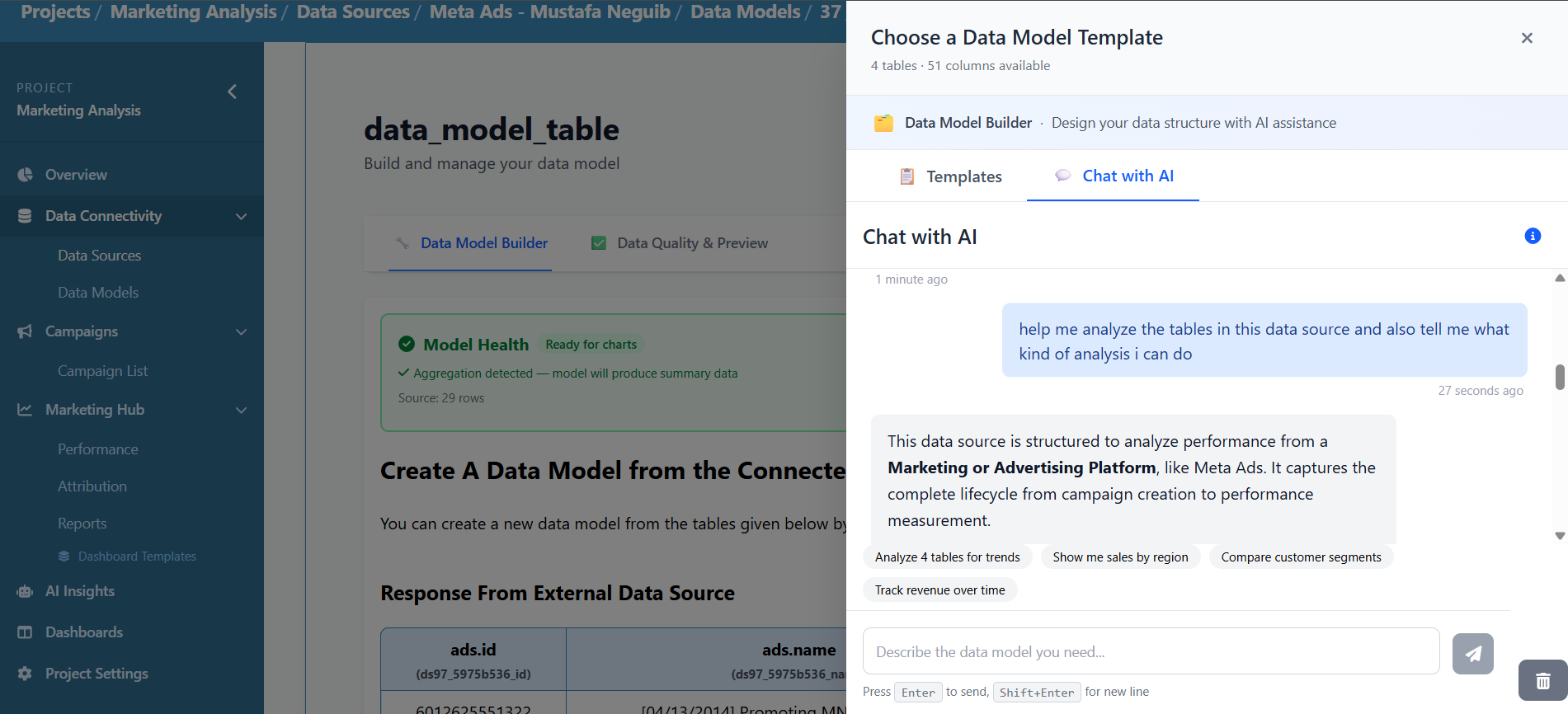 AI Data Modeler in action
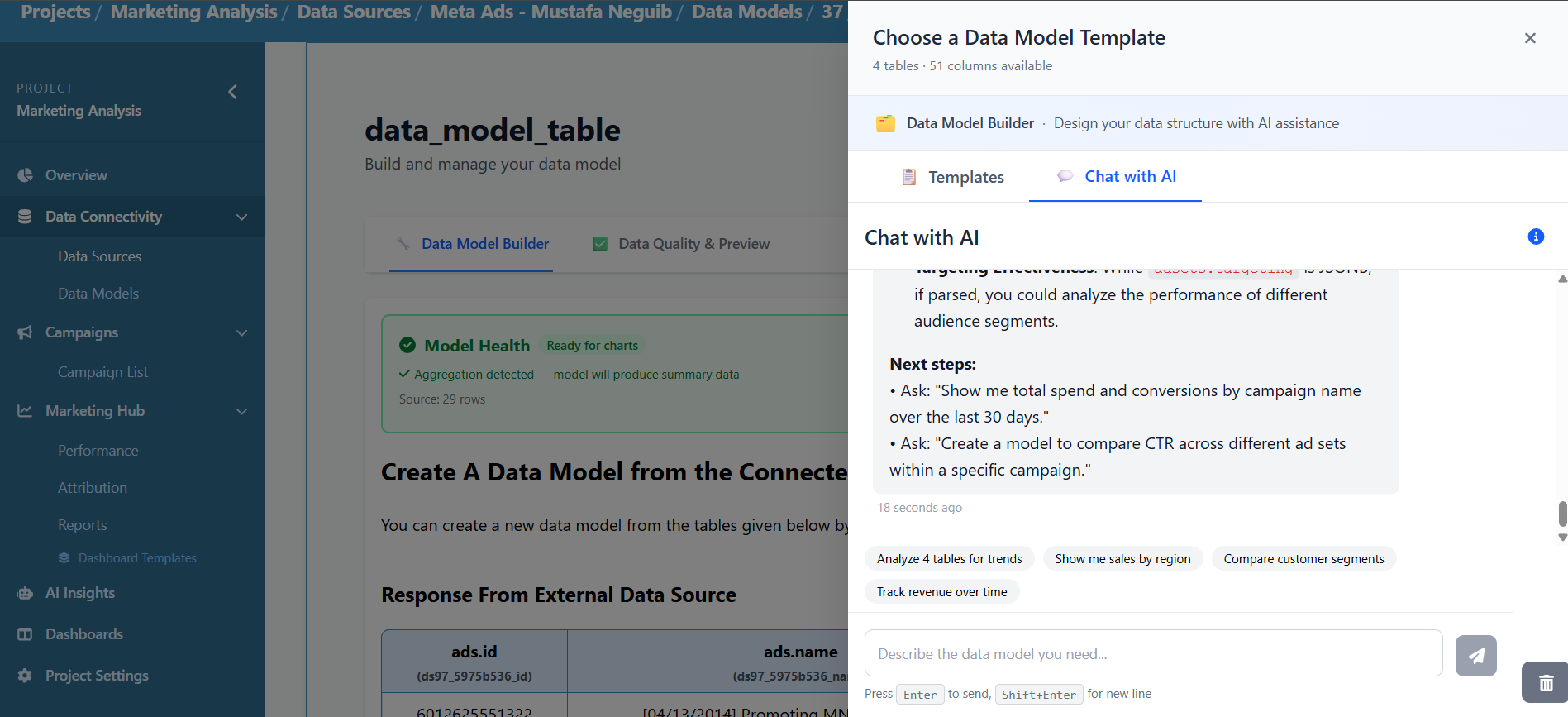 AI Data Modeler gives analysis and results to the user
5. How do you escape the trap?
Action Plan:
Audit your report lag. Track every request your team makes for a custom report. Count the hours between ask and answer. Multiply by your loaded team cost. That is your invisible drain.
Identify your most frequent queries. The five questions you ask most often reveal where a modeled answer replaces a manual query.
Connect your revenue data. Bring your ad spend, CRM, and payment data into one view. The AI Data Modeler cannot answer questions it cannot see.
Test one question in plain English. Ask your platform: "What was net profit by channel last month including all fees?" If the answer takes more than 60 seconds, your stack is still in the trap.
Stop translating. Start leading.
👉 Stop translating your data. Read The Technical Translation Trap.
FAQ
Q: Do I need to replace my existing BI tools? A: No. The AI Data Modeler sits on top of your existing stack. It generates the queries your BI tools need to show relevant answers.
Q: Can it handle non-standard metrics like fully loaded CAC with agency fees? A: Yes. The Federated Query Layer joins your ad platform data with PDF price lists and contract tables. No manual spreadsheet math required.
Q: How long does setup take for a mid-market stack? A: Connect your data sources. The AI Data Modeler infers relationships between user IDs, email addresses, and transaction IDs using Magic Joins. Most teams go live in under a week.
Q: Does my team need training? A: No. Your team asks questions in English. The engine does the rest.
Q: How do I know the answers are accurate? A: The platform must show you every query it runs. If you cannot see the SQL, you cannot trust the answer. DRA surfaces every generated query before execution.
References
Bettati, A., Jeff Jacobs, J., Robinson, K., & Tas, R. (2025, June 16). The CMO's comeback: Aligning the C-suite to drive customer-centric growth. McKinsey & Company. https://www.mckinsey.com/capabilities/growth-marketing-and-sales/our-insights/the-cmos-comeback-aligning-the-c-suite-to-drive-customer-centric-growth
CMO News Desk. (2026, May 22). CMO blind spot: 72% lack real-time data in 2026. https://cmonewsdesk.com/cmo-blind-spot-72-lack-real-time-data-in-2026/
Gartner. (2025, May 12). Gartner 2025 CMO spend survey reveals marketing budgets have flatlined at 7.7% of overall company revenue [Press release]. Business Wire. https://www.businesswire.com/news/home/20250512782208/en/
Gartner. (2026, May 11). Gartner 2026 CMO spend survey finds CMOs allocate 15.3% of marketing budgets to AI, but only 30% are ready to scale AI capabilities [Press release]. https://www.gartner.com/en/newsroom/press-releases/2026-05-11-gartner-2026-cmo-spend-survey-finds-cmos-allocate-15-point-3-percent-of-marketing-budgets-to-ai-but-only-30-percent-are-ready-to-scale-ai-capabilities
HubSpot. (2025). The state of marketing automation. HubSpot Research. https://www.hubspot.com/marketing-statistics
IAB. (2026). State of data 2026: The AI-powered measurement transformation. https://www.iab.com/insights/2026-state-of-data-report/