
Summary: Your marketing stack has 14 tools. None of them talk to each other. Your team spends three hours a day reconciling data from GA4, your CRM, your ad platforms, and a spreadsheet that never matches the bank account. That is not a stack. That is a part-time job you did not budget for. At a CMO's hourly rate, that is $45,000 a year spent on data janitor work. The 2026 frictionless stack eliminates that cost entirely.
1. What is a marketing stack?
The Answer: A marketing stack is the collection of tools a marketing team uses to run campaigns, measure performance, and manage customer data. It includes your CRM, email platform, ad manager, analytics tool, and everything in between. Most teams run 14 or more disconnected tools. The problem is not the number of tools. It is that they do not share a common data foundation.
Why this matters for your budget
If your tech budget is under $10,000 a year, you are probably using free tools — GA4, spreadsheets, maybe a cheap CRM. That works until you need to answer one question: "Which channel actually drove revenue?" Without a unified data layer, that question takes hours. The frictionless stack solves this without requiring a $100,000 data warehouse.
2. What does the frictionless marketing stack actually look like in 2026?
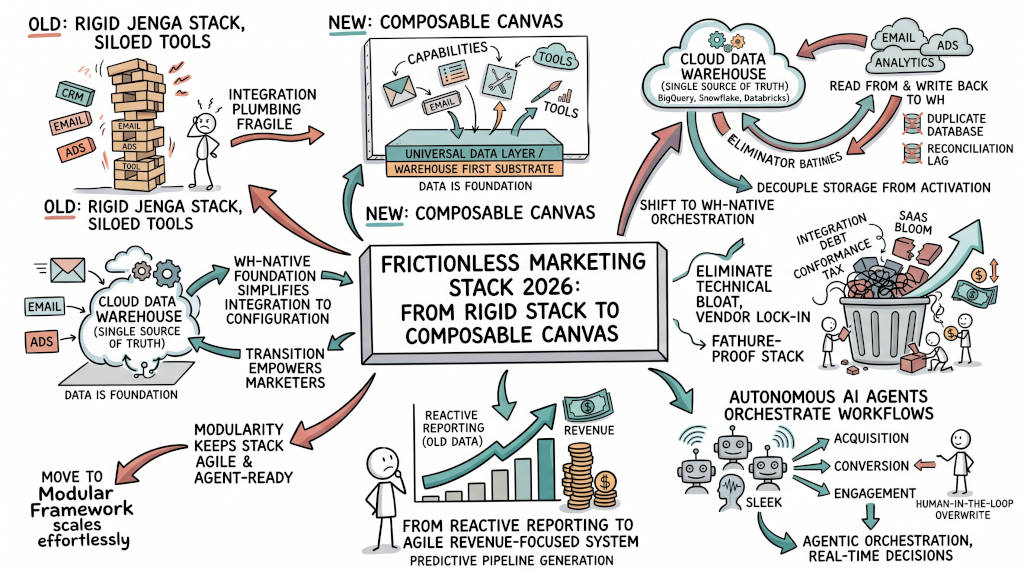
The Answer: It is not a rigid stack of vertical Jenga blocks. It is a composable canvas centered on a universal data layer (Brinker, 2026; Pragmatic Digital, 2026). The frictionless architecture replaces fragile integration plumbing with a warehouse-first substrate. Every tool, agent, or app interacts with this core. Integration complexity collapses. Capabilities become fluid.
Moving from integration to proximity
The architecture follows a concentric model: data at the center, capabilities composed around it, agents executing at the edge (Pragmatic Digital, 2026). Proximity to the data core is the new hierarchy. Tools that live closer to the warehouse require less integration overhead and deliver higher decisioning fidelity.
The warehouse-first advantage for small teams
You do not need Snowflake or a dedicated data team. A warehouse-native stack works with PostgreSQL. DRA's Federated Query Layer joins GA4, SQL, and ads data where it lives — no data copying required. For a team of five, that eliminates the second data person you thought you needed.
3. What is included in a modern marketing stack?
The Answer: A complete stack needs six categories: a data foundation (your warehouse or query layer), analytics and attribution (reports that match your bank account), activation tools (email, ads, CRM), content management (CMS, DAM), experience optimization (testing, personalization), and governance (privacy, consent, access control). Most teams have the activation tools. They are missing the data foundation that makes those tools accurate.
B2C vs. B2B: Same stack, different priorities
B2C teams need real-time attribution across paid, organic, and social. B2B teams need pipeline-to-revenue tracking through a CRM. A warehouse-native stack supports both because the data layer is shared. You swap the activation tools, not the foundation.
4. Why do monolithic platforms fail to solve the "SaaS Bloom"?
The Answer: Monolithic suites trade flexibility for convenience. When your business processes outgrow the platform's rigid logic, you accumulate integration debt (Martech360, 2026). You pay for features you cannot use while struggling to connect the specialized tools your strategy demands. Most marketing teams run 14-plus disconnected tools (1ClickReport, 2026). That creates silos that prevent AI from executing on unified data.
The cost of conformance for lean teams
Organizations choose suites to avoid managing infrastructure. Then they find their unique competitive advantages are lost because they must conform to standard workflows (Martech360, 2026). This conformance tax kills the strategic velocity required to compete (Martech360, 2026; 1ClickReport, 2026). For a team spending under $10K on tech, that tax is your entire budget.
5. What is the fundamental shift in data architecture for 2026?
The Answer: The shift is from copying data between tools to warehouse-native orchestration (Martech360, 2026; Trackier, 2026). Instead of trapping data inside proprietary SaaS silos, the modern architecture uses a cloud data warehouse as the single source of truth (House of MarTech, 2026b; Martech360, 2026). Tools connect to this core, read from it, and write back to it. That eliminates the duplicate database and reconciliation lag (House of MarTech, 2026b; Martech360, 2026).
Do not rip and replace
Build your data warehouse as the foundation first. Migrate individual high-value functions — analytics, attribution — to be warehouse-native. Keep your core execution systems intact (Trackier, 2026). DRA connects to your existing GA4, ads, and CRM data. You do not migrate. You connect.
6. How does agentic orchestration change the stack's role?
The Answer: In 2026, the stack is no longer just for reporting. It is a decision system (House of MarTech, 2026b). Autonomous AI agents act as the connective tissue. They plan projects, orchestrate multi-step workflows, and iterate based on performance signals (1ClickReport, 2026). The stack's role shifts from hosting static dashboards to powering predictive pipeline generation.
From pilot purgatory to production
Winning organizations do not just add AI tools. They align them to specific revenue workflows — acquisition, conversion, or engagement. They govern them with human-in-the-loop oversight to avoid the amplification trap, where AI scales errors faster than successes (1ClickReport, 2026).
7. How do you audit your marketing stack?
The Answer: Ask six questions. Who is this stack for? What are your marketing goals? What do you already have? Where are the gaps? What is your budget? Who owns governance? Answer these before adding any new tool. The most common mistake is buying a solution for a problem the data layer should solve.
A three-step start for under $10K
Step 1: Map your current tools. Write down every subscription. Delete any tool that duplicates a function. Step 2: Connect your data layer. Use a federated query tool to join GA4, ads, and CRM without moving data. Step 3: Pick one high-value use case — attribution or campaign reporting — and make it warehouse-native.
FAQ
Q: Is composable just another word for more integration work? A: It is a trade-off. You trade vendor lock-in for engineering overhead. It only makes sense if you have a warehouse-native foundation that simplifies integration to a configuration task (Martech360, 2026).
Q: Can a small team manage a composable stack? A: Yes. With disciplined governance and a tool like DRA that handles the data layer, composable becomes a configuration task, not a code-heavy effort (Martech360, 2026; Pragmatic Digital, 2026).
Q: How do we start without a data engineering team? A: Use a federated query layer. DRA's AI Data Modeler converts plain English into SQL. Your marketer writes the question. The system writes the query.
Q: What is the real cost of keeping our current disconnected stack? A: Three hours of reconciliation per day at a CMO's blended rate. That is $45,000 a year in lost strategic time. Plus the revenue you miss when campaigns run on stale data.
Q: Do we need Snowflake or BigQuery for a warehouse-native stack? A: No. PostgreSQL works. DRA uses PostgreSQL with Citus for columnar storage. Millions of rows in seconds. No six-figure data warehouse contract required.
CTA
Your stack is costing you in time, trust, and missed revenue. Connect your marketing spend to revenue with DRA. Start your plan today.
References
Brinker, S. (2026, March 19). Stacks on a plane: Reshaping martech on a universal data layer. Chiefmartec. https://newsletter.chiefmartec.com/p/stacks-on-a-plane-reshaping-martech-on-a-universal-data-layer
Chiefmartec. (2026, May 5). 2026 marketing technology landscape supergraphic: Peak martech achieved! https://chiefmartec.com/2026/05/2026-marketing-technology-landscape-supergraphic-peak-martech-achieved-maybe/
House of MarTech. (2026a, March 26). Composable vs monolithic MarTech: 2026 guide. https://houseofmartech.com/blog/composable-martech-vs-monolithic-platforms-which-architecture-fits-your-business-in-2026
House of MarTech. (2026b, April 4). Composable MarTech: API-first architecture framework. https://houseofmartech.com/blog/composable-martech-stack-implementation-api-first-architecture-decision-framework
MarTech Square. (2026, March 22). The MarTech canvas: New composable architecture standard. https://martechsquare.substack.com/p/the-martech-canvas-new-composable
Martech360. (2026, March 18). Lessons from advanced Martech stacks in 2026. https://martech360.com/insights/staff-writers/lessons-from-the-most-advanced-martech-stacks-of-2026/
Pragmatic Digital. (2026, March 15). The 2026 AI marketing tech stack: Tools, workflows & governance. https://www.pragmatic.digital/strategic-insights/ai-marketing-tech-stack
Trackier. (2026, May 13). Modern marketing data stack 2026: Architecture & frameworks. https://trackier.com/modern-marketing-data-stack/
1ClickReport. (2026, March 31). Composable data stacks for marketing 2026: Complete guide. https://www.1clickreport.com/blog/composable-marketing-data-stack-2026-guide