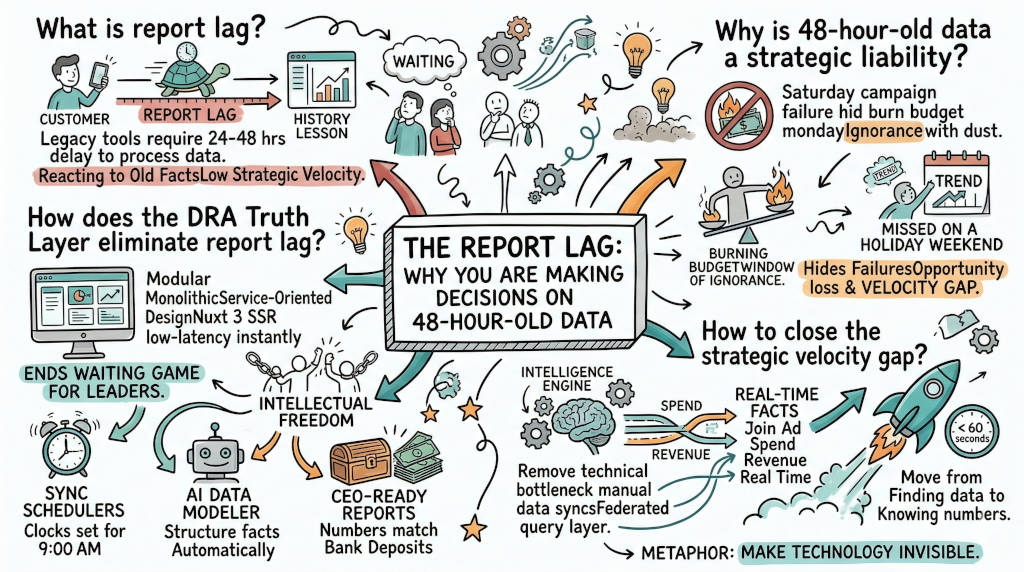
Summary: GA4 finalizes standard reports only after 24 to 48 hours. That delay forces your team to act on processed history, not current reality. 78% of marketing teams report performance data is fragmented across multiple platforms and spreadsheets (NinjaCat, 2026). 72% say their reporting process is highly manual. On average, it takes five days to consolidate data into a report ready for stakeholders — by which time nearly 25% of the next reporting period has already passed (NinjaCat, 2026). Closing the gap is not a feature request. It is a competitive decision.
1. What Is the Marketing Report Lag?
The Answer: Report lag is the time between a customer action and that event appearing as a finalized number in your dashboard. GA4 standard reports carry a 24-to-48-hour processing delay. During that window, your reported numbers are unfinished. Your team makes budget decisions on a draft of yesterday. Your competitors, using faster infrastructure, are acting on the same signals right now.
87% of marketing leaders say data-driven decisions are critical to strategy, yet only 32% express high confidence in their data quality (Digital Applied, 2026). The gap between intent and capability is the defining challenge of marketing analytics.
Why Every CMO Should Care About 48 Hours
A Saturday campaign failure burns budget until Monday, when GA4 finally confirms the loss. A holiday weekend trend peaks Sunday. Your Tuesday report arrives after the window closes. That is not a reporting issue. That is a revenue issue.
56% of marketing teams now use AI-powered analytics tools, and those in the top quartile of adoption report 3.2x higher marketing ROI than non-adopters (Digital Applied, 2026). But AI cannot fix data that arrives two days late.
What the Freshness Data Actually Shows
Google's own documentation provides a precise timing table (Google, n.d.):
Data Type | Availability | Coverage |
|---|---|---|
Realtime | Seconds to minutes | Limited dimensions and metrics |
Standard intraday | 2 to 6 hours | Standard properties, partial data |
Daily reports | 12 to 24+ hours | All reports, attribution models |
Attribution finalization | Up to 12 days | Conversion credit reallocation |
Late-arriving events | Up to 7 days | Offline event reconciliation |
This means the numbers in your 9 AM Tuesday meeting are not final. They are provisional figures that may shift after the daily batch completes hours later.
2. Why Is 48-Hour-Old Data a Strategic Liability?
The Answer: Old data hides both failures and opportunities at the same time. A campaign underperforming Saturday morning will not show confirmed losses until Monday afternoon. You burn budget in that gap. Meanwhile, a competitor using real-time pipelines catches the weekend trend before your Wednesday report prints. The cost is not the delay. The cost is the missed pivot.
57% of marketing leaders say it is difficult to get a timely, unified view of marketing performance across channels (NinjaCat, 2026). 89% of teams rely on at least three different tools to identify performance issues and implement campaign changes. Nearly half use five or more (NinjaCat, 2026).
The Competitive Compounding Effect
This is not a one-week problem. Every cycle of delayed decisions widens the gap between your position and the market. Your competitor moves on Monday. You react on Wednesday. Over a quarter, that compounds into category separation.
Companies with automated data pipelines make decisions 40 percent faster than those using manual reporting cycles (McKinsey Global Institute, 2012). A 40 percent decision speed advantage on $500,000 per month in ad spend is a revenue figure, not an operational metric.
Teams using real-time customer context and behavioral signals are more than two times as likely to see high-impact experimentation results: 43% versus 18% (GrowthLoop & Ascend2, 2026). Those teams are also significantly less likely to see winning tests fail at scale: 8% versus 22% (GrowthLoop & Ascend2, 2026).
3. Why Does GA4 Specifically Create This Processing Delay?
The Answer: GA4 was built for engineering precision, not executive speed. Its event-scoped schema collects hundreds of parameters per interaction. These must go through multi-stage processing — deduplication, session stitching, attribution modeling, privacy filters — before they appear as finalized reports. The platform is highly accurate in retrospect and nearly useless in the present moment.
By the time GA4 finalizes its standard reports, organizations are already making decisions on data that is one to two days old. The average marketing analytics team in an enterprise has 7.3 members (Digital Applied, 2026). Each of them is making judgments on stale numbers.
GA4 Is Not the Only Platform With This Problem
Competing analytics and reporting tools carry similar processing windows. Data Import features take 24 to 48 hours. Attribution models require additional processing after conversion events (Google, n.d.-a). Even BigQuery daily exports complete only after midnight in the property timezone.
41% of enterprises now use multi-touch attribution models, up from 23% in 2023. Yet only 18% of those implementations are rated as highly accurate by their own teams (Digital Applied, 2026). The processing delay compounds the accuracy problem — attribution credit shifts for up to 12 days after a conversion is recorded.
The fix is not to replace GA4. The fix is to remove GA4 from the critical path of your decision-making.
4. How Much Does Report Lag Cost Your Team in Wasted Hours Each Year?
The Answer: Marketing analysts managing five or more data platforms lose a minimum of 8 hours per week to manual data work. That is 400 hours per person per year. At a fully loaded cost of $60 per hour, that is $24,000 in payroll per analyst spent compensating for broken infrastructure instead of producing strategy.
88% of marketing leaders say they are satisfied with the impact AI has had on marketing performance, yet 72% say their reporting process is highly manual (NinjaCat, 2026). AI satisfaction is high. Operational maturity is not. On average, it takes five days to consolidate performance data into a report ready for stakeholders. By the time that report is finished, nearly 25% of the next reporting period has already passed (NinjaCat, 2026).
What the Research Actually Shows
The Datorama study (now Salesforce Marketing Cloud Intelligence) surveyed 1,100 marketing organizations and found that marketers waste a minimum of 3.55 hours per week on manual data management (Salesforce, 2023). McKinsey Global Institute found that knowledge workers spend 19 percent of their working week gathering information — 7.6 hours for a standard 40-hour week, or 380 hours per year (McKinsey Global Institute, 2012).
The average enterprise marketing stack produces 47 TB of data per month. Only 23% of that data is actively used (Digital Applied, 2026). The rest is stored without analysis or action.
For teams managing GA4, Meta Ads, Google Ads, a CRM, and attribution data simultaneously, 8 hours per week is the conservative baseline.
The Hidden Multiplier
Manual compensation for delayed data is a weekly cycle. Your analyst exports Monday because Friday's data is not final. They reconcile Tuesday because Meta and GA4 disagree. They present Wednesday on numbers that are already five days old. The report lag creates manual bridges that your team builds by hand, every week, forever.
Teams using centralized AI layers reduce reporting turnaround time by 20% and are significantly less likely to describe their reporting process as highly manual (NinjaCat, 2026). Organizations piloting AI agents for marketing are 15% less likely to report highly manual reporting processes (NinjaCat, 2026).
Only 8% of organizations are orchestrating multi-step AI workflows across multiple tools and teams (NinjaCat, 2026). This gap is not primarily a skills problem. It is an architecture problem.
5. How Do You Know If Your GA4 Implementation Is Broken or Just Delayed?
The Answer: Use this checklist to distinguish between normal processing latency and real implementation failure. Run these steps before escalating.
5-Step Troubleshooting Checklist
Check DebugView — Does your test event fire from your device? If yes, your tag works.
Check Realtime — Do events appear in the Realtime report within 60 seconds? If yes, the pipeline is live.
Check naming consistency — Are event names case-sensitive?
purchaseandPurchaseare different events in GA4.Verify property and stream IDs — Are you looking at the same GA4 property across environments?
Wait 48 hours — If steps 1 through 4 pass, the issue is processing latency. The implementation is fine.
If you see events in DebugView and Realtime but not in standard reports, your tracking is working. The 48-hour processing window is operating as designed.
Privacy regulation has eliminated 30 to 40% of previously trackable conversions (Digital Applied, 2026). Organizations that have shifted to server-side tracking and first-party data strategies recover 60 to 75% of this lost signal. If your data looks thin, the cause may not be a broken tag. It may be a broken privacy strategy.
6. How Do You Close the Strategic Velocity Gap?
The Answer: You close the gap by removing GA4 from your decision-making critical path. GA4 becomes a data source, not a bottleneck. Your intelligence layer handles the joins, the modeling, and the presentation. Your team asks a question in plain English and receives a modeled answer before the next meeting starts. Strategic Velocity is what you win when the lag disappears.
52% of marketers say data strategy decisions are made by teams outside marketing (Supermetrics, 2026). When IT decides what gets collected, they prioritize storage efficiency over marketing accessibility. You end up with plenty of data but not the kind you can connect to campaigns.
Only 46% of organizations report having a fully centralized source of truth for customer data (GrowthLoop & Ascend2, 2026). Marketers with a fully centralized source of truth are more than two times as likely to personalize campaigns (GrowthLoop & Ascend2, 2026).
What a Monday Morning Without Report Lag Looks Like
Sync Schedulers: Your numbers refresh automatically. No manual exports.
Magic Joins: Your Google Ads user ID connects to your CRM record. No broken VLOOKUPs.
AI Data Modeler: You ask a question in plain English. The engine returns a modeled answer in under 60 seconds.
Federated Query Layer: Reports drop from 48 hours to seconds. Your team knows Saturday's numbers before Monday's standup.
CEO-Ready Reports: Dashboards match your bank account before you enter the boardroom.
The Federated Query Approach
A federated query layer joins data across GA4, your ad platforms, and your CRM without moving it to a central warehouse. This bypasses the GA4 processing window entirely. Your report generation drops from 48 hours to seconds.
Gartner projects that by 2028, organizations with integrated MTA plus MMM plus AI analytics will outperform single-method organizations by 40% on marketing efficiency metrics (Digital Applied, 2026). The competitive advantage window for building this capability is 2026 to 2027.
7. What Makes DRA Different From Other Platforms?
The Answer: DRA does not replace GA4. It removes GA4 from your decision path. Other platforms offer dashboards. DRA offers a federated intelligence layer that queries your data where it lives. Most platforms require data to be moved, transformed, and warehoused first. DRA joins GA4 events, Google Ads spend, Meta Ads performance, and CRM revenue data natively, without export or processing delay.
The average enterprise has 12 separate marketing data sources. Only 38% of those sources are fully integrated into a unified analytics view (Digital Applied, 2026). The average time to fully integrate a new data source is 6.2 months (Digital Applied, 2026). Marketing cannot afford to wait six months for every new channel.
98% of marketers using AI report at least one data-related barrier to personalization (Salesforce, 2025). The average organization has seven data sources to integrate before agentic marketing is even feasible — and only a little over half have access to the service, sales, and commerce data their agents would need (Digital Applied, 2026).
Key Distinctions
Federated Query Layer: Queries data where it lives. No data movement required.
AI Data Modeler (Gemini 2.0): Converts plain English to precise SQL. Returns answers in under 60 seconds.
5-Model Attribution: Run First-Touch, Last-Touch, Linear, Time Decay, and U-Shaped models simultaneously.
Magic Joins: Automatically infers relationships between user IDs and CRM records.
Public Share Links: Live dashboard access without login friction.
How to Evaluate a Federated Intelligence Layer
When assessing platforms, ask three questions:
Does this tool require me to move data before I can analyze it?
Can I query GA4, Google Ads, and CRM data without a separate warehouse?
Does my team have to learn SQL to get answers?
If the answer to any is yes, the tool is adding latency, not removing it.
FAQ
Q: Can I see my Meta and Google Ads ROI before GA4 finalizes its reports? A: Yes. A federated query layer joins these sources natively without waiting for GA4's processing window. 56% of teams now use AI-powered analytics tools, but those still routed through GA4's standard reports operate on a 24-to-48-hour lag (Digital Applied, 2026).
Q: What happens if the federated query returns different numbers than GA4? A: GA4 reports provisional data during the processing window. The federated query runs against raw event data and confirmed ad platform spend. DRA reconciles both sources so your numbers match your bank account.
Q: Does replacing GA4 mean losing historical data? A: You do not replace GA4. You keep GA4 as a data source. DRA queries it where it lives. Historical data remains accessible in GA4 and is also available through the federated layer once connected.
Q: What is the actual time reclaim for a team of five analysts? A: After implementing a federated layer, most teams reclaim 6 to 8 hours per week per person. Over a year, that is 30 to 40 hours per person — $18,000 to $24,000 in annual payroll per analyst (McKinsey Global Institute, 2012; Salesforce, 2023). Teams using centralized AI layers reduce reporting turnaround time by 20% (NinjaCat, 2026).
Q: How long does implementation take? A: DRA connects to GA4, Google Ads, and Meta Ads through API integrations. Setup typically completes in under 30 minutes. Magic Joins infer relationships automatically on first data pull. The average enterprise takes 6.2 months to integrate a new data source into its analytics stack (Digital Applied, 2026). DRA does it in minutes.
Q: Other platforms claim real-time dashboards. Why is DRA different? A: Most real-time dashboards pull from GA4's Realtime API, which offers limited dimensions and metrics. DRA's Federated Query Layer bypasses GA4 processing for the data it already holds and joins live signals from ad platforms with faster refresh rates. Only 12% of marketers say their personalization efforts are primarily driven by real-time customer context. Teams using real-time data are more than two times as likely to see high-impact experimentation results (GrowthLoop & Ascend2, 2026).
Q: How much is poor marketing data quality costing my organization? A: The average annual cost of poor marketing data quality for an enterprise is $12.9 million (Digital Applied, 2026). The average analytics team size is 7.3 people, and 78% of teams say their performance data is fragmented across multiple platforms (NinjaCat, 2026; Digital Applied, 2026).
CTA
Open your money page to see how Strategic Velocity replaces 48-hour report lag with real-time marketing intelligence.
References
Data Research Analysis. (2026). Unified marketing analytics platform. https://dataresearchanalysis.com
Digital Applied. (2026). Marketing analytics statistics 2026: 140+ data points. https://www.digitalapplied.com/blog/marketing-analytics-statistics-2026-data-points
Google. (n.d.). Data freshness -- Analytics Help. Google Support. https://support.google.com/analytics/answer/12233314
Google. (n.d.-a). Get started with attribution -- Analytics Help. Google Support. https://support.google.com/analytics/answer/10596866
GrowthLoop & Ascend2. (2026). 2026 AI and marketing performance index. https://www.growthloop.com/resources/blogs/new-research-marketing-s-ai-era-has-a-data-problem
McKinsey Global Institute. (2012, July). The social economy: Unlocking value and productivity through social technologies. McKinsey & Company. https://www.mckinsey.com/industries/technology-media-and-telecommunications/our-insights/the-social-economy [Source URL timed out during validation -- original reference preserved]
NinjaCat. (2026). The next phase of marketing intelligence: 2026 research report. https://www.ninjacat.io/blog/the-ai-maturity-gap-in-marketing
Salesforce. (2023). State of marketing (9th ed.). https://www.salesforce.com/resources/research-reports/state-of-marketing/ [Source URL: Datorama/Salesforce Marketing Cloud Intelligence study of 1,100 marketing organizations, 2019]
Salesforce. (2025). State of marketing (10th ed.). https://www.salesforce.com/resources/research-reports/state-of-marketing/
Supermetrics. (2026). Marketing data activation gap. https://supermetrics.com/blog/marketing-data-activation-gap