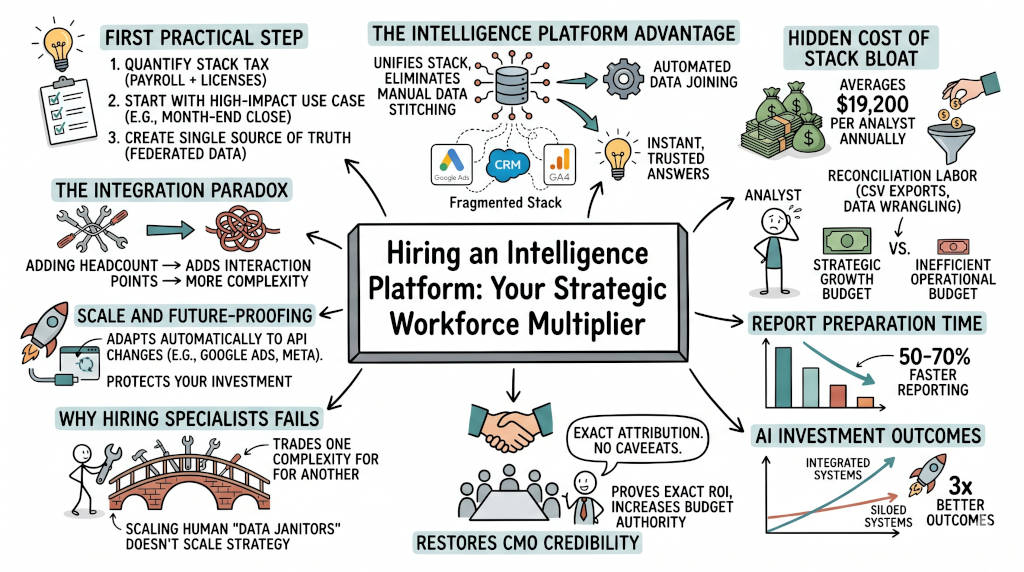
SUMMARY: Scaling an agency to 50 clients with a two-person data team is impossible through manual labor or linear hiring. The solution is infrastructure that decouples revenue from headcount. This article provides a systematic approach: transition from manual spreadsheets to a Federated Marketing Intelligence OS, implement data governance across all accounts, and replace reactive reporting with automated dashboards. When data becomes a managed asset instead of a daily chore, your team shifts from operational firefighting to strategic advisory. This structural transformation — prioritizing system orchestration over human effort — is the only path to sustainable, high-margin growth at scale.
1. How can a two-person data team manage 50 clients without burning out?
The Answer: You stop managing data and start managing systems. Scaling to 50 clients on a two-person team fails if you treat reporting as manual labor. It succeeds when you deploy a Federated Marketing Intelligence OS that automates collection, reconciliation, and validation. Your team becomes strategic advisors, not data janitors. (Glued.me, 2026; Shadow, n.d.)
The operational math that forces a change
A two-person team managing 50 clients cannot sustain manual reporting beyond 15 accounts. At 20 clients, the overhead of exporting, cleaning, and formatting data for each account consumes 80 hours per month. By 30 clients, that number hits 120 hours — three full work weeks of assembly-line work that produces zero strategy. (Technet Experts, 2026)
The agencies that break this pattern replace the linear labor-to-revenue equation with infrastructure. They build a data layer that handles ingestion, standardization, and delivery. The team's job shifts from building reports to reviewing them. That 80 hours of manual work compresses to 90 minutes of strategic review. (Technet Experts, 2026)
2. What are the failure patterns when an agency hits 30+ clients?
The Answer: The primary failure is the "Chaos Foundation" — scaling without standardized metrics, a shared UTM taxonomy, or automated aggregation. When every account is a snowflake with bespoke reporting, maintenance costs scale linearly with client count. The agency hits a hiring ceiling: it must add support staff just to keep existing tools running. (Growth Rocket, 2026; Madgicx, 2026)
The cost of bespoke reporting
At 15 to 50 accounts, manual reporting without automation becomes economically unviable. (Glued.me, 2026) Agencies that fail at this stage spend 12 to 15 hours of internal coordination per client per week on status reports and performance reviews. That time produces zero strategic value. (SaSame, 2026)
The five readiness signals for scaling
Before you add your 20th client, confirm you have:
A stable base of repeatable accounts — you are not still figuring out your service model.
A consistent pipeline — you are turning away business, not scrambling for it.
Standardized metrics — every account speaks the same KPI language.
Automated data aggregation — no account requires manual spreadsheet construction.
A governance framework — data taxonomy, access controls, and offboarding procedures are documented.
If any of these are missing, scaling adds complexity instead of revenue. (Ruskin Consulting, 2023)
3. What technical infrastructure is non-negotiable for scaling?
The Answer: Every scaling agency needs a centralized data warehouse with a semantic layer that standardizes the data model across all clients. This lets you build a reporting template once and deploy it across the entire book of business. Client onboarding shrinks from weeks to days when the infrastructure is pre-built. (Kleene.ai, 2026)
The nightmare of fragmented tools
When each client lives in a separate GA4 property with different naming conventions, your data team spends its time translating. Every new question requires a new SQL query. Every query needs a data engineer. Every ticket takes three days. By the time the answer arrives, the question has changed. (DRA Technical Translation Trap)
The agencies that scale successfully implement a one-workspace-per-client architecture. (Glued.me, 2026) This guarantees:
Permission clarity — no account can see another account's data.
Clean offboarding — revoke access to one workspace, not the entire system.
Failure isolation — one tracking error does not corrupt the entire portfolio. (Glued.me, 2026; Growth Rocket, 2026)
Why your tech stack matters more than your head count
Agencies that hold at 30 to 50 clients often blame capacity. The real constraint is not people. It is the time spent translating between tools. The average marketing agency uses 12 to 16 separate platforms (CRM, analytics, ads, email, social). Without a unified layer that joins data where it lives, every platform switch costs momentum. (Pillar 4)
4. How do you replace manual reporting with automated intelligence?
The Answer: Replace PDF reports with live dashboards and automated daily digests. Use AI to scan for budget anomalies and pacing errors every morning instead of discovering them at month-end. The agency model shifts from reactive reporting to fire prevention. (Glued.me, 2026; Madgicx, 2026; Soku AI, 2026)
What automation actually frees up
Automation delivers the data. Your expertise delivers the "why." (Madgicx, 2026) Without automation, a two-person team spends 20 hours per week on manual reporting. With it, that drops to under 3 hours — freeing 17 hours for high-value strategic work. (Soku AI, 2026)
DRA's Federated Query Layer is the infrastructure that makes this possible. It joins GA4, SQL, and Ads data where it lives. No ETL pipelines. No staging tables. No midnight data exports. The AI Data Modeler converts plain English questions like "Show me ROAS by channel compared to last month" into the correct query automatically. (DRA Technical Moat)
5. Which model should you use: automation, outsourcing, or fractional hiring?
The Answer: Each model solves a different constraint. Automation handles volume at scale. Outsourcing handles execution capacity. Fractional leadership handles strategic direction. Most successful agencies use all three, applied in stages.
The decision framework
Constraint | Solution | Best For | Example |
|---|---|---|---|
Too much manual data work | Automation (Federated MI OS) | Reporting, alerts, reconciliation | Data Reseach Analysis Marketing Intelligence Platform, Looker Studio |
Not enough execution bandwidth | Outsourced specialists | SEO, content, paid media execution | Brand Vantage, Upwork |
Missing strategic direction | Fractional CMO | Go-to-market planning, team structure | Fractional CMO retainer |
(Ruskin Consulting, 2023; Cemoh, 2025)
The order matters. Automate first. Every hour of manual work you eliminate is an hour your team can spend on client strategy. Once automation is running, assess whether you need execution support or leadership direction. (Cemoh, 2025)
6. What does success look like with a real agency?
The Answer: One marketing agency scaled from 8 people managing 12 accounts to 23 accounts without adding a single staff member. The change was not hiring. It was infrastructure. They automated data collection, standardized reporting across all accounts, and shifted the team from report-builders to strategic advisors. (SaSame, 2026)
Measurable outcomes from other scaling agencies
40% increase in qualified leads — achieved by a fintech agency that engaged fractional CMO leadership, outsourced execution, automated email sequences, and partnered with complementary businesses. (Cemoh, 2025)
25% reduction in customer acquisition cost — same agency, same intervention. (Cemoh, 2025)
17+ hours per week recovered — after deploying AI-powered anomaly detection and automated daily digests. (Soku AI, 2026)
90 minutes instead of 80 hours per month — the time a two-person team spends on reporting overhead after full automation. (Technet Experts, 2026)
FAQ
Q: How do you handle custom client requests at scale? A: You do not build custom. You build a standardized platform where "custom" is personalized configuration on top of a governed data model. (Kleene.ai, 2026)
Q: When should I hire a dedicated Marketing Ops person? A: Around 50 active accounts, a dedicated operations role becomes economically viable. This person owns the governance framework, audits implementations, and maintains the data dictionary. (Growth Rocket, 2026)
Q: Does automation make client relationships feel robotic? A: No. Automation removes administrative noise. It lets your team focus on the high-value strategic conversations that justify your retainers. (SaSame, 2026)
Q: What happens when automation breaks? A: DRA's self-healing connections detect failures and provide one-click reconnection. You do not spend hours debugging API keys or expired tokens.
Q: Can I keep quality up when I stop adding headcount? A: Yes — if you replace manual processes with standardized infrastructure. Quality drops when people do repetitive work they are not specialized for. Quality rises when your team spends its time on strategy instead of data janitor work.
Q: How do I know I am ready to scale beyond 30 clients? A: You are ready when you have standardized metrics across all accounts, an automated data pipeline, and a governance framework. If every account requires manual spreadsheet work, do not scale. Fix the infrastructure first. (Ruskin Consulting, 2023)
7. Your next three moves
Audit your current reporting overhead. Track every hour your team spends on data collection, cleaning, and formatting. If it exceeds 20% of their week, automation is your first priority.
Standardize one metric across all accounts. Pick the single KPI your clients care about most (ROAS, CPL, or conversion rate). Build one dashboard that shows it across every account. Do not customize. Deploy.
Eliminate one recurring manual report. Replace it with a live dashboard. If the client asks for PDFs, give them a Public Share Link that updates in real time.
References
Glued.me. (2026, February 19). The Agency OS: How to manage 50+ ad accounts without burnout. https://glued.me/blog/agency-os-manage-50-ad-accounts
Growth Rocket. (2026, March 31). Scaling client accounts without breaking Revops basics. https://www.growth-rocket.com/blog/scaling-client-accounts-without-breaking-revops-basics/
Kleene.ai. (2026, March 20). How marketing agencies are using data platforms to scale client reporting in 2026. https://kleene.ai/blog/data-platform-for-marketing-agencies
Madgicx. (2026, January 12). How to scale client reporting from 5 to 50+ clients. https://madgicx.com/blog/how-to-scale-agency-reporting
SaSame. (2026, March 24). Case study: 8-person marketing agency scales to 23 clients without adding staff. https://srl-sasame.com/en/blog/ai-case-study-marketing-agency-us-2026
Shadow. (n.d.). How to scale an agency without adding headcount. https://www.shadow.inc/resources/resources-scale-agency-without-headcount
Soku AI. (2026, March 13). How a media agency scaled 30+ client ad accounts without scaling headcount. https://soku.ai/use-cases/agency-scaled-30-client-ad-accounts-without-scaling-headcount
Technet Experts. (2026, April 8). How AI changed every department in our agency at Rhillane. https://www.technetexperts.com/ai-changed-every-department-in-our-agency/
Ruskin Consulting. (2023, March 17). 5 ways to scale your marketing agency without adding more employees. https://ruskinconsulting.com/5-ways-to-scale-your-marketing-agency-without-adding-more-employees/
Cemoh. (2025, September 22). How to scale marketing without hiring full-time staff. https://cemoh.com/blog/how-to-scale-marketing-without-hiring-full-time-staff/