Summary: Fragmented MarTech stacks drain mid-market marketing teams, wasting $93,750 per year on manual data stitching for just five analysts. This article defines what a marketing intelligence platform is, explains why AI chatbots cannot replace persistent data infrastructure, addresses enterprise data security risks of public AI tools, provides a stack tax calculator, lists six core capabilities to evaluate, and shows how on-premise deployment with local LLMs keeps sensitive data inside your network while restoring CMO credibility with the CFO.
Your MarTech stack was supposed to make decisions faster. Instead, your team spends 40% of its time stitching data between tools that refuse to talk to each other (Digiday Research Team, 2026). Every quarter, your CFO asks why the numbers do not match the bank account. You have dashboards. You do not have answers. A marketing intelligence platform fixes the infrastructure. Here is exactly how.
1. What Is a Marketing Intelligence Platform?
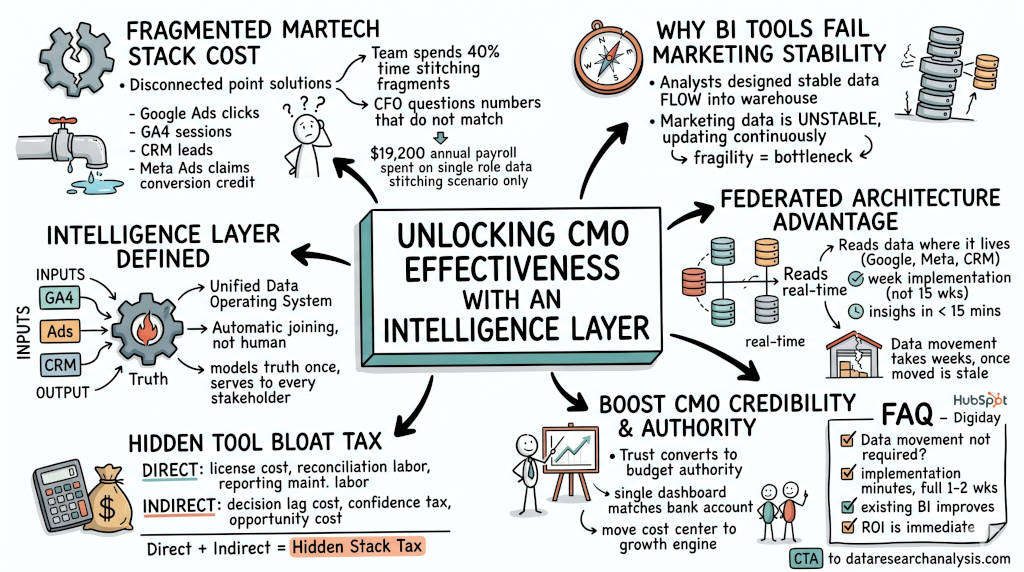
The Answer: A marketing intelligence platform sits above your existing tools and connects them directly. Google Ads, GA4, your CRM, and every other platform keep running. The intelligence layer reads from each source where the data lives. It joins the results automatically. It delivers one truth to every stakeholder. No migration. No warehouse project. No waiting (Salesforce, 2026).
How It Differs From BI Tools and Analytics Dashboards
BI tools like Tableau and Looker assume stable data flowing into a clean warehouse. Marketing data is unstable. It arrives from 12 to 15 sources. It updates continuously. It changes format without warning (Gartner, 2025).
BI tools describe what happened — after an analyst has stitched it together. A marketing intelligence platform shows what is happening now. It tells you what to do about it.
Traditional analytics dashboards are rear-view mirrors. An intelligence layer is the windshield.
2. Why Does Your Marketing Stack Cost More Than It Saves?
The Answer: You pay for the tools. You also pay for the labor to make them work together. Your senior analyst spends Monday mornings exporting CSV files. Your marketing director spends Wednesday afternoon reconciling numbers that do not match. Your CFO questions why the bank account shows different revenue than your dashboards report. The infrastructure cost exceeds the value the tools generate (Beet.TV, 2026; Haus, 2026).
The Hidden Cost of Fragmentation
The mathematics are simple. An analyst earning $75,000 per year spends 10 hours per week on tool integration and reconciliation. That is $18,750 in annual payroll spent on data stitching. For one role.
Scale that across a team of five. You are spending $93,750 per year on work that a connected platform eliminates (Strategic Pete, 2026).
This is not a reporting problem. It is a structural problem. When tools cannot communicate natively, humans must translate. Translation costs money. It also introduces error (Digiday Research Team, 2026).
3. Why Can't I Just Use AI Tools Like ChatGPT for This?
The Answer: AI chatbots answer questions. They do not build persistent data infrastructure. ChatGPT can summarize a CSV file you upload. It cannot sit above your Google Ads, GA4, CRM, and Meta Ads simultaneously — pulling live data, resolving identity conflicts, and serving one truth to your entire team. An intelligence layer is infrastructure. A chatbot is a conversation (Gartner, 2026).
The Infrastructure Difference
Open a chatbot. Ask it: "Which channel drove the most incremental revenue last month across all sources?" It cannot answer. It has no connection to your data. It has no memory of last week's query. It has no persistent model of your attribution logic.
A marketing intelligence platform has all three. It connects to every source. It remembers every query. It models attribution continuously (Salesforce, 2026; Gartner, 2025).
The best chatbots give you opinions. An intelligence layer gives you numbers that match your bank account.
Think of it this way. ChatGPT is like asking a smart consultant a question over coffee. The intelligence layer is the operating system your entire marketing department runs on. One is clever. The other is structural. Only the second one gets you through a board meeting (Roberts, 2026).
The Data Security Risk You Cannot Ignore
Every time an employee pastes campaign data, revenue figures, or customer records into a public AI chatbot, that data leaves your perimeter. It enters a model provider's servers. It may be retained for training. It may surface in someone else's generation.
Enterprises cannot accept this risk. Most have explicit policies against uploading sensitive data to third-party AI tools. Yet marketing teams routinely violate these policies because they have no alternative that works (Digiday Research Team, 2026).
An on-premise marketing intelligence platform solves this. The data never leaves your network. The platform connects to your Google Ads, GA4, and CRM from within your own infrastructure. It runs local LLM models for query processing. The AI works against your data without the data ever touching a public API.
This is not hypothetical. A marketing intelligence platform deployed on-premise gives you the query power of an AI assistant with the security of a closed network. Your CISO approves it. Your CFO trusts it. Your team uses it without breaking compliance rules (Gartner, 2026).
4. How Much Budget Is Hidden in Your Tool Bloat?
The Answer: The exact number depends on your team size, payroll, and stack design. Use your own inputs. Do not rely on generic benchmarks. A defensible ROI case uses real license spend, real labor hours, and real decision lag cost (Beet.TV, 2026; Haus, 2026).
Calculating Your Real Stack Tax
Direct cost model:
Annual tool licenses = sum of all analytics, attribution, ETL, and reporting tools
Annual reconciliation labor = total reconciliation hours per year × loaded hourly payroll
Annual reporting maintenance = dashboard QA, connector fixes, schema repairs (Strategic Pete, 2026)
Indirect cost model:
Decision lag cost = delayed budget moves × estimated performance delta
Confidence tax = time spent in executive meetings resolving metric disputes
Opportunity cost = strategy projects delayed by reporting maintenance (Haus, 2026)
Total hidden stack tax = direct costs + indirect costs
Strategic Pete reports that businesses often discover three to five forgotten tools during audits, each costing $2,000 to $5,000 annually. When you calculate the True Cost with all categories included, the real number is often 40 to 60% higher than the ad-spend-only figure (Strategic Pete, 2026).
5. What Core Features Should a Marketing Intelligence Platform Deliver?
The Answer: Six capabilities separate infrastructure that drives performance from tools that centralize dashboards. Every feature depends on the data layer beneath it. If the layer is shallow, the features are decorative (Gartner, 2025).
The Six Capabilities That Matter
1. Unified Data Management. The platform pulls data from paid media, organic search, CRM, web analytics, email, and offline transactions. It standardizes schemas. It harmonizes naming. It resolves identities across systems (Salesforce, 2026).
2. Cross-Channel Performance Analytics. Compare channels on a like-for-like basis. Which campaigns drive incremental revenue. Which audiences convert profitably. Which placements deliver value versus inflate spend (Gartner, 2025).
3. Multi-Touch Attribution. Your BI tool shows that LinkedIn drove $500K in revenue last month. Your CFO asks: "How much came from prospects we first touched on Google Ads three months ago?" A marketing intelligence platform answers in seconds. It runs First-Touch, Last-Touch, Linear, Time-Decay, and U-Shaped models simultaneously. According to an industry audit, only 23% of CMOs report full confidence in their marketing attribution numbers (HubSpot, 2026).
4. Predictive Analytics. ML models forecast which audiences will respond, what budgets will yield against target ROAS, and where channel saturation is approaching diminishing returns. The output is not a guarantee. It is a structured probability (Gartner, 2025).
5. Real-Time Reporting. Reporting that lags by a week is reporting against decisions already made. Modern platforms provide near-real-time visibility into pacing, creative fatigue, audience softening, and channel delivery. Eighty-three percent of marketing leaders prioritize demonstrating ROI, but only 36% can measure it accurately today (Firework, 2025).
6. Automated Optimization. The platform does not just recommend. It acts. Budget pacing adjusts mid-flight. Audience segments refresh against incoming behavioral data. Bids recalibrate against changing inventory pricing. Human strategists set rules and review outputs. The tempo runs faster than any manual team (Gartner, 2025; Gartner, 2026).
6. What Happens When You Add an Intelligence Layer to Your Existing Stack?
The Answer: You do not delete your current tools. GA4, Google Ads, Meta Ads, and your CRM stay in place. They continue generating data. The intelligence layer connects to all of them simultaneously. It models relationships automatically. It serves unified reports to your team. Your BI tool connects to the intelligence layer for cross-functional reporting. Your team stops stitching. They start moving (Salesforce, 2026).
The Federated Architecture Advantage
Most organizations try to centralize data by moving it to a warehouse. This approach fails because data movement takes weeks. Once moved, data is stale — your warehouse refreshes nightly while your campaigns are live 24/7. Ownership confusion follows: does IT own the warehouse, or Marketing? (Digiday Research Team, 2026; Beet.TV, 2026)
A federated approach connects to data where it lives. Google Ads stays in Google. GA4 stays in Google. Your CRM stays where it is. The intelligence layer reads from each source simultaneously and joins results in real time.
The result: faster implementation and fresher answers. Organizations using this model reduce report preparation time by 70% and eliminate the manual reconciliation step entirely (Data Research Analysis, 2026).
Most implementations serve their first attribution report within 15 to 30 minutes of connection. Full onboarding takes one to two weeks.
7. How Does a Marketing Intelligence Platform Drive ROI for Your CMO Credibility?
The Answer: It connects spend to revenue directly. It proves attribution. It eliminates dashboard wars where sales claims different numbers than marketing. When your CFO and head of sales see the same truth — sourced from the same layer — the arguments stop. You restore executive trust. Trust converts to budget authority (Roberts, 2026; Adweek, 2026).
The Board Meeting Advantage
Enter your quarterly board meeting with one dashboard. Every number matches your bank account. Your CEO asks: "Which million should we move to SEO?" You answer in 90 seconds with exact numbers. You do not wait for a report. You do not hedge with caveats. You lead with certainty (Adweek, 2026).
This credibility compounds. Prove ROI three quarters in a row. Your budget requests get approved faster. You move from cost center to growth engine.
NIQ reports that 74% of CMOs say they are under more scrutiny to prove marketing ROI than ever before (NielsenIQ, 2025). McKinsey found that 70% of CEOs measure marketing impact based on year-over-year revenue growth and margin, but only 35% of CMOs track those metrics as a top priority. That 35-point gap is the precise distance between where marketing thinks its job ends and where the business thinks it begins (Bettati et al., 2025). An intelligence platform closes it.
8. Common Mistakes to Avoid When Evaluating an Intelligence Platform
The Answer: Three errors kill most evaluations before they start. Avoid them and your shortlist shrinks from dozens to two or three (Haus, 2026; Strategic Pete, 2026).
Mistake 1: Treating It Like Another Dashboard
Dashboards show you what happened. Intelligence platforms tell you what to do. A dashboard is passive. A platform is active. If the vendor's demo is 90% charts and 10% action, you are buying a dashboard with better branding (Salesforce, 2026).
Mistake 2: Ignoring the Integration Question
Ask this: "How many of my actual data sources does this platform connect to without custom engineering?" If the answer involves months of pipeline work, walk away. The platform should connect to Google Ads, GA4, Meta Ads, your CRM, and major data warehouses natively. Custom integrations should be rare (Gartner, 2025).
Mistake 3: Underestimating the Operating Model
The platform does not run itself on day one. You need clean source data or a credible plan to get there. You need a defined owner inside marketing. You need willingness to revisit measurement frameworks rather than port the old ones unchanged. Vendors handle the technical lift. The operating model decisions sit with you (Beet.TV, 2026; Haus, 2026).
FAQ
Q: Do I need to move my data to use a marketing intelligence platform? A: No. A true intelligence platform reads from your existing sources without moving data. It connects to Google Ads, GA4, your CRM, and other platforms where they live. A federated query layer joins results in real time (Salesforce, 2026).
Q: How long does implementation take? A: First attribution reports appear within 15 to 30 minutes of connection. Full onboarding typically takes one to two weeks. Compare that to a data warehouse migration, which often runs three to six months (Beet.TV, 2026; Data Research Analysis, 2026).
Q: Will my existing BI tool become obsolete? A: No. Your BI tool connects to the intelligence layer to pull clean, modeled data for cross-functional reporting. This improves your BI output while reducing the burden on your analysts (Salesforce, 2026).
Q: What if my tech stack includes tools not commonly integrated? A: Modern intelligence platforms use federated query architectures. If your tool has an API, the platform can connect to it. Custom integrations are uncommon (Gartner, 2025).
Q: How do I know if my current stack needs an intelligence platform? A: If your team spends more than five hours per week reconciling data between tools, if report preparation takes more than one day, or if your CFO questions your attribution numbers — you need one (Beet.TV, 2026; Haus, 2026).
Q: Can AI chatbots replace a marketing intelligence platform? A: No. AI chatbots answer questions. They do not build persistent connections to your live data sources. They cannot model attribution continuously across 12+ platforms. They cannot serve one truth to your entire organization. A chatbot is a conversation tool. An intelligence platform is operating infrastructure (Gartner, 2026).
The ROI Is Immediate. The Conversation Should Start Now.
Stop managing software. Start moving at the speed of your strategy. A marketing intelligence platform consolidates your entire marketing data stack into a single source of truth. Your team reclaims 200+ hours per year. Your CFO sees exact ROI. Your board sees a CMO who leads with numbers.
The question is not whether to add an intelligence platform. The question is how much runway your competitors gain while you are still reconciling spreadsheets.
Prove the ROI to your CEO. See exactly how much hidden cost sits inside your current stack and what a unified layer would unlock for your team. Show your CEO the numbers.
References
Digiday Research Team. (2026). Marketers' AI use rises, but tech skills stall. https://digiday.com/marketing/digiday-research-marketers-ai-use-rises-but-tech-skills-stall/
Salesforce. (2026). State of marketing report 2026. https://www.salesforce.com/news/stories/state-of-marketing-2026/
Gartner. (2025, May 12). 2025 CMO spend survey: Marketing budgets flat at 7.7% of revenue. https://www.gartner.com/en/newsroom/press-releases/2025-05-12-gartner-2025-cmo-spend-survey-reveals-marketing-budgets-have-flatlined-at-seven-percent-of-overall-company-revenue
Beet.TV. (2026, April). Retail media wants your budget, but it needs to earn it: Bayer's Ryan Verklin. https://www.beet.tv/2026/04/retail-media-wants-your-budget-but-it-needs-to-earn-it-bayers-ryan-verklin.html
Haus. (2026, March 18). Half of marketing leaders can't defend how they measure ROI. https://www.prnewswire.com/news-releases/half-of-marketing-leaders-cant-defend-how-they-measure-roi-boards-are-starting-to-notice-302716554.html
Strategic Pete. (2026, May 19). Marketing audit checklist: 15 areas every CEO must review. https://strategicpete.com/blog/marketing-audit-checklist-ceo-review-areas/
Gartner. (2026, May 18). CMOs face pressure to deliver AI growth. Business Chief. https://businesschief.com/news/gartner-cmos-face-pressure-to-deliver-ai-growth
Roberts, E. (2026, May 21). How CMOs prove ROI to CEOs and CFOs in uncertain markets 2026. ChiefViews. https://chiefviews.com/how-cmos-prove-roi-to-ceos-and-cfos-in-uncertain/
HubSpot. (2026). State of marketing report 2026. https://www.hubspot.com/state-of-marketing
Firework. (2025). Marketing ROI statistics. https://firework.com/blog/marketing-roi-statistics
Data Research Analysis. (2026). Customer implementation data: Report preparation time reduction and reconciliation elimination.
Adweek. (2026, May 12). How CMOs should actually think about ROI. https://www.adweek.com/brand-marketing/how-cmos-should-actually-think-about-roi/
NielsenIQ. (2025, November 19). CMOs face a 'reputation and results' reckoning. https://nielseniq.com/global/en/news-center/2025/cmos-face-a-reputation-and-results-reckoning-according-to-niqs-2026-outlook/
Bettati, A., Jacobs, J., Robinson, K., & Tas, R. (2025, June 16). Tapping into the full power of CMOs. McKinsey & Company. https://www.mckinsey.com.br/capabilities/growth-marketing-and-sales/our-insights/the-cmos-comeback-aligning-the-c-suite-to-drive-customer-centric-growth