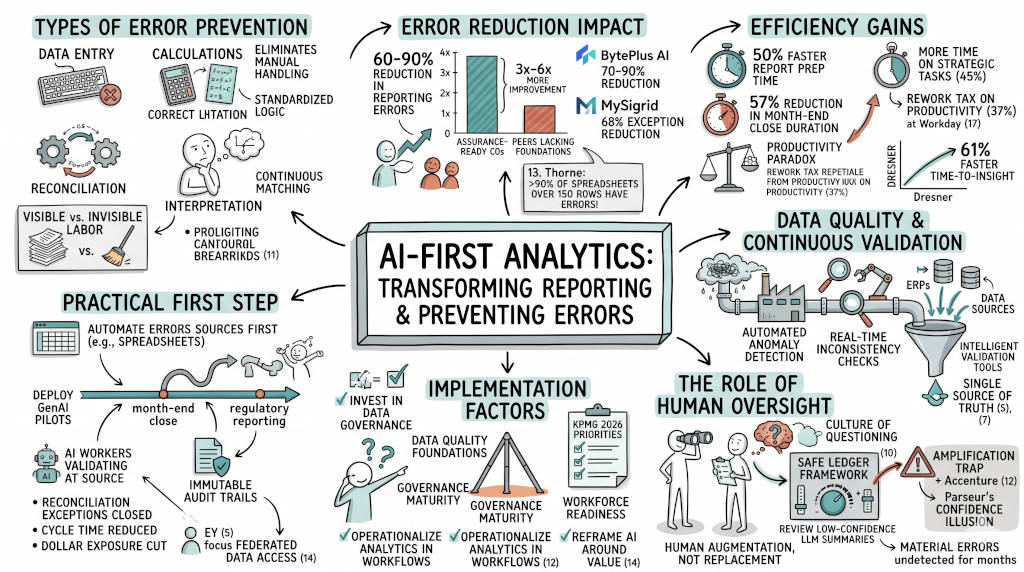
Summary: Your next hire should not be another marketing data analyst. It should be an AI intelligence platform. Your analyst spends 400 hours per year on data maintenance. That is $19,200 in reconciliation labor per person — salary spent on plumbing, not strategy. An intelligence platform removes that work entirely. Data connects automatically. Reports update in real time. Your best people shift from wrangling spreadsheets to finding growth. The cost of one analyst's data janitor work covers the platform. The outcome is faster decisions, trusted attribution, and a team that does not burn out.
1. Why should you replace your marketing data analyst with an AI platform?
The Answer: You should replace your marketing data analyst with an AI platform because your analyst spends 60 percent of their time reconciling spreadsheets instead of finding growth. An intelligence platform does the reconciliation in seconds. Organizations report 50-70% faster reporting and elimination of manual reconciliation (Flint, n.d.).
The MarTech Stack Mess is the real villain
Your analyst is not the problem. The stack is. Fifty-three percent of marketing leaders say their tools are a barrier to alignment (Bain & Company, 2025). GA4 talks to Meta. Meta talks to LinkedIn. LinkedIn talks to your CRM. None of them talk to each other. Your analyst becomes the human translator between five systems that were built by companies that do not cooperate.
That is not analysis. That is infrastructure maintenance. And you are paying a salary for it.
The numbers do not lie
A marketing data analyst earns a median of $74,680 per year. Research shows they spend 400 hours per year on data maintenance alone (Atlassian, 2025). At a blended hourly rate of $48, that is $19,200 in pure reconciliation labor (Flint, n.d.). You are not buying analysis. You are buying data plumbing.
An AI intelligence platform costs a fraction of that. It never sleeps. It never requests a raise. And it connects GA4, SQL, and ad platforms where they live. The analyst role transforms from pipe-fitter to strategist. The cost of inaction is an entire salary spent on tasks a machine can do in milliseconds.
2. What is an intelligence platform and how does it work?
The Answer: An intelligence platform is software that connects your marketing tools, cleans and models the data, and answers questions in plain English. It uses machine learning to detect patterns, natural language processing to understand your questions, and automated pipelines to keep data fresh. You never export a CSV again.
Machine learning finds what you miss
ML models scan your data for shifts in performance. A campaign starts declining on Tuesday. The platform flags it on Tuesday. Your analyst would see it on Thursday after running the weekly pull. That 48-hour gap is Pillar 2 in action. The Strategic Velocity Gap kills campaigns before you know they are failing (KPMG, 2026).
Natural language means no SQL required
You type "show me cost per lead by channel for Q3." The platform understands it. It queries the data. It returns a chart. The AI Data Modeler converts your English into complex SQL. You do not need a query writer on staff. You need a platform that speaks your language.
Automated data pipelines end the refresh cycle
Your analyst exports data every Monday. They paste it into a template. They check for errors. They send it Tuesday. The platform does this continuously. Every join is automatic. Magic Joins infer relationships between user IDs and email addresses. The Federated Query Layer pulls from all sources at once. The data is always current.
3. Old way vs new way: hire an analyst or deploy a platform?
The Answer: The old way hires a human to move data between tools. The new way deploys a platform that moves data automatically. The old way produces reports on Tuesday about last week. The new way produces answers on Monday about this morning. The old way costs $74,680 plus benefits. The new way starts at zero and scales with your data volume.
Old way: hire an analyst
You post a job. You interview ten candidates. You hire one. You wait four weeks for onboarding. Your new analyst spends month one learning your tool stack. Month two building dashboards. Month three reconciling discrepancies. Month four producing the first report you can trust. That is a third of a year before you see value.
The analyst then maintains this process. API changes break custom integrations every 8-12 times per year on average (Advertising Week, 2022). Every schema update requires a manual fix. The analyst becomes the system. If the analyst leaves, the system breaks.
New way: deploy an intelligence platform
You create an account. You connect your tools. The platform auto-discovers schemas. It normalizes fields across sources. "Cost" from Facebook. "Spend" from Google. "Investment" from LinkedIn. The platform maps them to one metric.
You ask your first question in plain English. You get your first answer in seconds. You see results immediately. No onboarding. No vacation risk. No departure risk. The platform is the system. The system never leaves.
Side-by-side comparison
Task | Analyst | Platform |
|---|---|---|
Data extraction | 4 hours weekly | Automated |
Cross-source reconciliation | 6 hours weekly | Instant |
Report generation | 3 hours weekly | Real-time |
Answer ad-hoc query | 2 hours | 3 seconds |
Schema change response | 2 weeks | Auto-adaptive |
Annual cost | $74,680+ | Fraction |
4. Can an AI platform really handle five different attribution models?
The Answer: Yes. Data Research Analysis runs 5-Model Attribution simultaneously. First-Touch, Last-Touch, Linear, Time-Decay, and U-Shaped models report side by side in real time. Your last analyst could run one model at a time and took three days to switch. The platform runs all five on the same query. You see the full attribution picture without waiting.
Why simultaneous attribution matters
A single attribution model is a lie you tell yourself. Only 23% of CMOs report full confidence in their marketing attribution numbers (Marketing Memo, 2026). Last-Touch credits the final click. First-Touch credits the discovery. Neither tells the full story. Your board wants to know which channels drive revenue. Your analyst runs one model and calls it truth.
The platform runs five models at once. You compare them. You see where models agree and where they diverge. You walk into the boardroom with numbers that match the bank account. That is Pillar 3 solved. The Executive Trust Gap closes when the dashboard matches reality.
5. What about the data my team already has in PDFs and static files?
The Answer: The platform reads PDFs. The PDF Data Source extracts table data from static price lists, competitor contracts, and supplier agreements. Your analyst could not do this without manual data entry. The platform does it in one upload. That data becomes queryable. It becomes joinable. It becomes useful.
PDFs are the last data frontier
Most marketing teams have critical data trapped in PDFs. Agency rate cards. Competitor pricing sheets. Historical campaign summaries from previous vendors. Your analyst either retypes this data or ignores it. Both are bad.
The platform extracts the table. It normalizes the columns. It joins the data with your live marketing feeds. You suddenly have historical context for current performance. You ask "how does this quarter compare to the contract baseline?" The platform answers. Your analyst never had time to answer that question.
6. How quickly can I implement this and when will I see results?
The Answer: Implementation takes days, not months. Connect your data sources in under an hour. The Federated Query Layer joins GA4, your data warehouse, and ad platforms where they live. You get your first report the same day. Full deployment with team training takes one to two weeks. Results start in hour one.
Implementation roadmap
Week one day one: Create your account. Connect GA4, Meta Ads, LinkedIn, and your SQL warehouse. The platform auto-discovers tables and fields.
Week one day two: Your first dashboard populates. Verify numbers against your last manual report. The AI Data Modeler translates your first English query.
Week one day three: Invite your team. Assign roles. Your analyst now focuses on interpretation, not extraction.
Week two: Train on 5-Model Attribution and Public Share Links. Share a live dashboard with your CEO. No login required. No PDF export. No friction.
Week three: Full adoption. Your team stops exporting CSVs. Your analyst starts producing strategy documents. Your board sees real-time numbers that match the bank account.
When NOT to use an AI platform
You should not replace your analyst if your data is not digital. If you run campaigns on paper invoices and verbal agreements, a platform cannot help. You should not deploy a platform if your team has zero data literacy. Someone must still ask the right questions. The platform answers. It does not invent strategy.
You should not expect a platform to replace human judgment. The platform eliminates data drudgery. It does not eliminate strategic thinking. Your best analysts become your best strategists. The platform gives them time to think.
7. How does this fix my team's burnout problem?
The Answer: Pillar 7 is real. Marketing analysts leave because the work is exhausting, not because it is hard. Teams waste 400 hours per year on manual data maintenance (Shno.co, n.d.). Four hundred hours per year of data maintenance is soul-crushing. The platform takes the drudgery. The analyst keeps the craft. Retention improves. Morale improves. Output improves.
The Invisible Drain destroys teams
Your team does not quit because they hate marketing. They quit because they spend more time with spreadsheets than with strategy. The Invisible Drain is 400 hours per year of work that adds zero value. It is the most expensive hidden cost in your department.
An intelligence platform removes those 400 hours. Your analyst now does what you hired them to do. They find patterns. They test hypotheses. They present recommendations. They go home feeling like a marketer instead of a clerk. Your team stops replacing talent every 18 months (Digiday Research Team, 2026).
8. Can I keep my existing MarTech stack?
The Answer: Yes. The platform is a layer that connects your existing tools. It does not replace them. The Federated Query Layer reads from GA4, your data warehouse, and ad platforms without moving data. You keep your stack. You add intelligence on top, so you can connect marketing spend to revenue in one place.
No rip and replace
Most platform vendors ask you to migrate. They want you to rebuild your data infrastructure inside their walls. That takes months. It introduces errors. It locks you in.
DRA sits on top. It queries your sources where they live. Your GA4 stays. Your SQL stays. Your ad platforms stay. The platform joins them without migrating them. You keep your existing contracts. You keep your existing workflows. You add speed and accuracy.
FAQ
Q: How long does it take to see a return on investment? A: Most teams see ROI in the first month. The platform eliminates 400 hours of manual work per year. That is $19,200 in reclaimed labor cost per analyst. The platform pays for itself before the first quarter ends.
Q: Will my current analysts lose their jobs? A: No. Their roles change. They stop doing data entry and start doing strategy. The analyst who adapts becomes more valuable. The analyst who resists will struggle. But the platform creates strategists. It does not eliminate people.
Q: Can the platform handle custom data sources? A: Yes. If your data lives in SQL, the Federated Query Layer reads it. If your data lives in a PDF, the PDF Data Source extracts it. If your data lives in a spreadsheet, upload it. The platform adapts to your data. You do not adapt to the platform.
Q: What happens to my data during implementation? A: Nothing changes. The platform reads your sources. It does not move or duplicate your data unless you choose to cache for performance. Your source systems remain unchanged. Your existing reports remain unchanged until you decommission them.
Q: Do I need a data engineer on staff to run this? A: No. The platform handles schema discovery and field normalization automatically. Magic Joins infer relationships between user IDs and email addresses. The AI Data Modeler converts plain English into SQL. Your team does not write pipelines.
Q: How do I share reports with my CEO and board? A: Public Share Links. Generate a live dashboard link. No login required. No PDF export. The CEO opens the link and sees real-time data. The board sees numbers that match the bank account. No preparation time. No anxiety.
Q: What happens if the platform goes down? A: Your source data stays intact. The platform is a query layer. If the platform is unavailable, your source tools still work. You can still log into GA4. You can still pull reports from your ad platforms. The platform adds speed. It does not create dependency.
CTA
Learn more and connect marketing spend to revenue in one platform.
References
Bain & Company. (2025, December 10). Too much marketing technology, too little impact. https://www.bain.com/de/insights/too-much-marketing-technology-too-little-impact/
ConvertMate. (2026, March 29). State of AI orchestration in marketing 2026. https://www.convertmate.io/index.php/research/ai-orchestration-marketing-2026
Flint. (n.d.). 30 marketing technology integration ROI statistics. https://www.tryflint.com/blog/marketing-technology-integration-roi-statistics
Gartner. (n.d.). Boost martech performance and prepare for AI. https://www.gartner.com/en/marketing/topics/marketing-technology
Marketing Memo. (2026, April 17). Marketing analytics statistics for 2026. https://www.revenuememo.com/p/marketing-analytics-statistics
Shno.co. (n.d.). Martech adoption statistics for 2026. https://www.shno.co/marketing-statistics/martech-adoption-statistics
Workiva. (2026, February 2). Executive benchmark survey. https://newsroom.workiva.com/press-releases/workiva-executive-benchmark-survey-finds-instability-accelerating-data-automation
Advertising Week. (2022, September 13). Keeping up with walled garden API changes requires automation. https://advertisingweek.com/keeping-up-with-walled-garden-api-changes-requires-automation/
Atlassian. (2025). State of teams 2025. https://www.atlassian.com/blog/state-of-teams-2025
KPMG. (2026, May 1). AI adoption in finance doubles. https://kpmg.com/xx/en/media/press-releases/2026/05/ai-adoption-in-finance-doubles-but-assurance-readiness-determines-who-wins.html
Digiday Research Team. (2026). Marketers' AI use rises, but tech skills stall. https://digiday.com/marketing/digiday-research-marketers-ai-use-rises-but-tech-skills-stall/
HubSpot. (2026). State of marketing report 2026. https://www.hubspot.com/state-of-marketing